The Remote-Hire Playbook: How I'm Approaching Cold Emails, Outreach, and Automation to Land a Remote AI/ML Internship
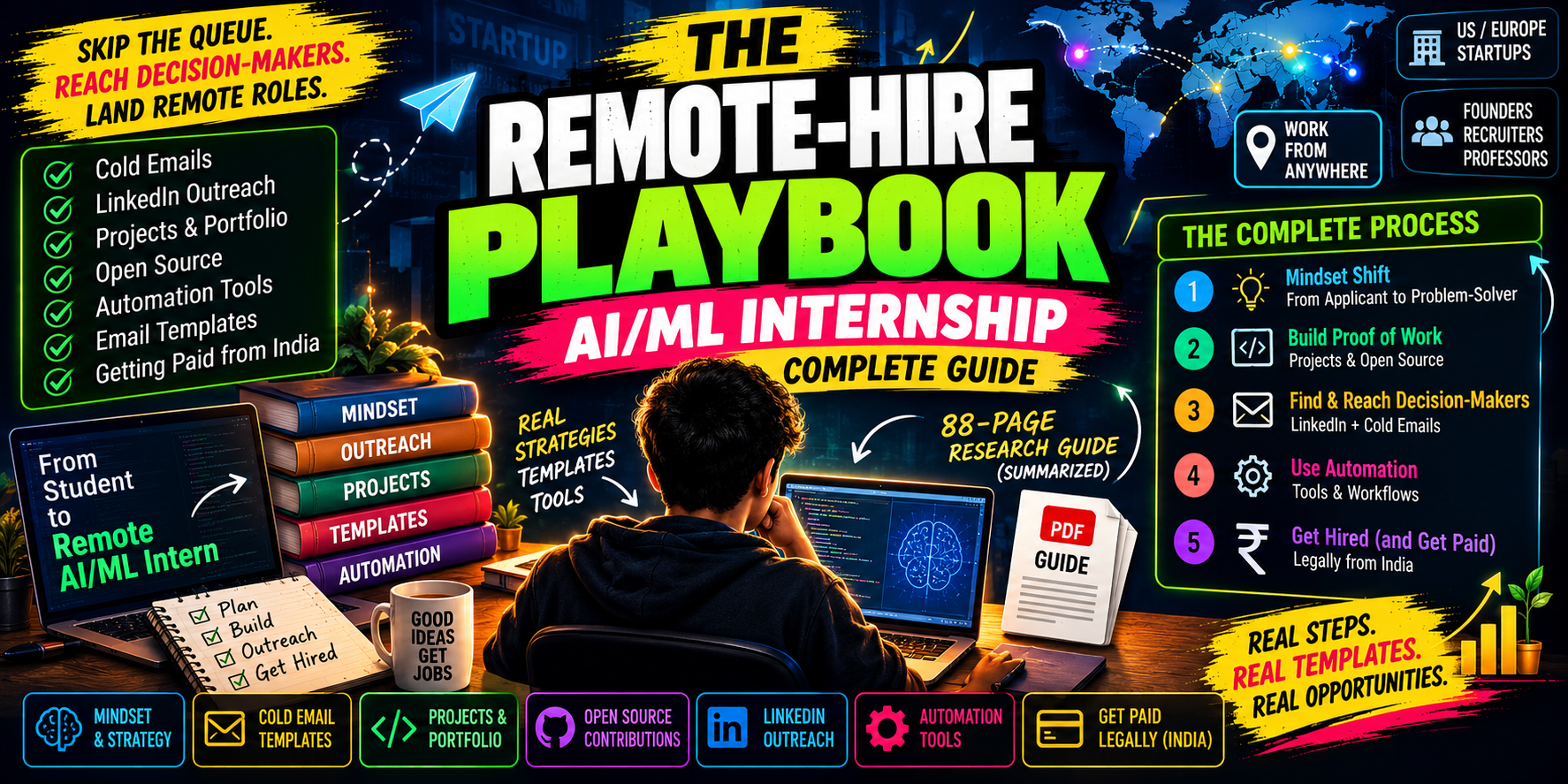
This article is a guided tour of a problem I am working through right now: how does a student with a resume, some projects, and no famous college-brand-name pipeline actually get in front of the people who can hire him? Over the last few weeks I collected videos, field manuals, toolkits, and cold-email breakdowns, and merged them into a single 88-page guide. This post is the long-form summary of that guide — the mindset, the math, the process, the templates, the tools, and the caveats — written for students, early-career engineers, and anyone tired of watching their applications disappear into a portal.
In this guide: Why I wrote this and how to read it → the mindset shift from “applicant” to “problem-solver” → the outreach equation (why cold outreach is arithmetic, not luck) → proof-of-work track one: production-grade projects → proof-of-work track two: open-source contributions → positioning and LinkedIn → the step-by-step process for reaching startup founders → cold-email fundamentals → templates for professors, recruiters, investor-portfolio companies, and internships → automating the whole machine → creating openings where no job is posted → getting paid legally from India → a 16-week roadmap → whether paid programs are worth it → quick-reference numbers, checklists, and a glossary → and the link to the full PDF plus every video and resource I went through.
1. Why I Wrote This (and What This Post Is — and Isn’t)
I’m a B.Stat student at the Indian Statistical Institute, Kolkata, and I’m currently in the middle of the exact problem this post describes: trying to turn a resume full of statistics, machine learning, and programming work into an actual AI/ML internship. Like most people in this position, I started where everyone starts — job portals, Easy Apply buttons, and a growing pile of applications that never got a reply.
Somewhere along the way I started watching videos and reading manuals on a different approach: skip the queue, find the people who actually make hiring decisions, show them proof of what you can do, and ask for a small, specific next step. The more I read, the more the different sources seemed to converge on the same handful of ideas — even though they were aimed at different audiences (remote-job seekers, freelancers, students chasing internships, people emailing professors).
So I did what I always do when I’m trying to understand something: I turned it into a document. That document became The Remote-Hire Playbook, a single reorganized reference covering everything from mindset to money. Nothing from the sources is dropped; it’s just restructured into one coherent system.
A few honest notes before we start:
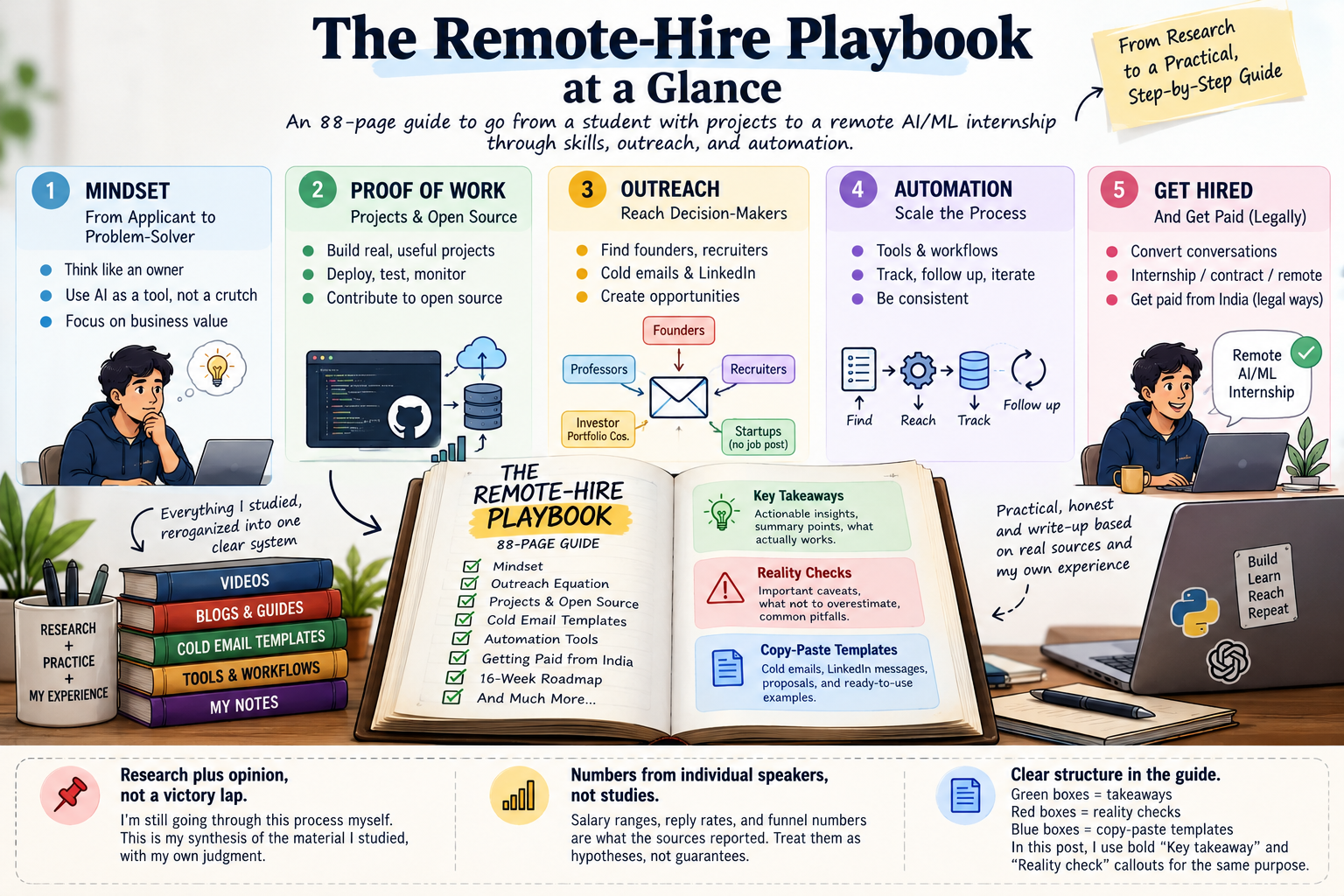
- This is research plus opinion, not a victory lap. I’m still going through this process myself. Everything here is my synthesis of the material I’ve studied, plus my own judgment about what seems solid and what seems oversold.
- Most numbers come from individual speakers, not studies. Salary ranges, reply rates, and funnel numbers in this post are what the sources reported. I flag them as such throughout, and you should treat them as hypotheses worth testing, not guarantees.
- The guide’s structure is deliberate. Green boxes in the PDF are takeaways, red boxes are reality checks, and blue boxes are copy-paste templates. In this post, I use bold “Key takeaway” and “Reality check” callouts for the same purpose.

2. The Mindset Shift: From Applicant to Problem-Solver
2.1 The Central Argument
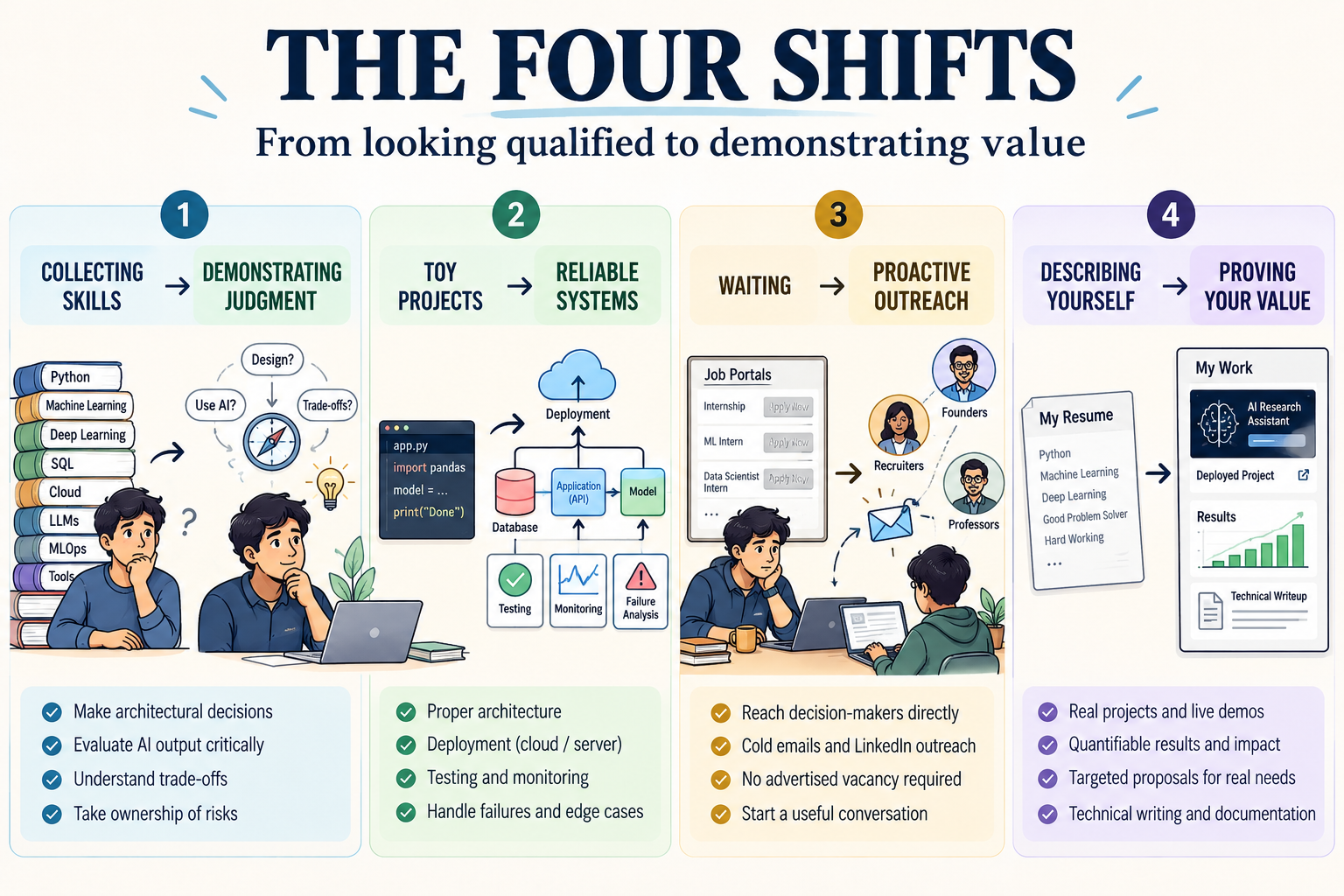
The starting premise shared across almost every source is simple: most talented engineers over-invest in collecting technical skills and applying through conventional portals, and under-invest in three things that actually move hiring decisions:
- Technical judgment — using AI to accelerate development, but personally making the architectural decisions, evaluating what AI produces, understanding failures, and owning the risk.
- Direct access to decision-makers — building relationships with founders and hiring managers instead of depending entirely on application portals.
- Personal marketing — demonstrating business value through projects, technical writing, and targeted outreach rather than listing skills on a resume.
Key takeaway: The overall philosophy is to move from being an applicant who asks for a job to a problem-solver who demonstrates why a company should hire them. Every later section builds one of these three capabilities.
2.2 The Opportunity: Funded Startups Hiring Remotely
The target in most of the sources is small, venture-funded startups in the US and Europe — often around 20–40 employees. That combination (real budget, small headcount) is what makes them reachable: founders may personally read LinkedIn messages and emails, there are fewer layers of HR screening, and a company may consider someone who demonstrates a useful capability even without an advertised opening.
| What the source claims | Approximate figure cited |
|---|---|
| Funding raised by target startups | $5M, $10M, or $20M+ |
| Company size | ~20–40 employees |
| Potential annual remote salary | $60,000–$100,000 (≈ ₹50–85 lakh) |
| Hiring approach at the cited example company | Direct outreach and referrals, not job postings |
Reality check: These are figures and anecdotes from a single speaker, not independently verified market statistics. High salaries are possible, not assured. Remote-work eligibility, geographic pay policies, and visa or contract arrangements all affect real compensation — and the range may not reflect what is typical for early-career applicants based in India. For an internship, the numbers will be very different.
2.3 Why the Conventional Approach Often Fails
The standard path looks like this: gain a couple of years of experience, finish courses and certifications, build projects, write a resume, and apply broadly — competing against hundreds of applicants for a handful of vacancies, with recruiters and ATS software standing between you and the person who actually needs your skills. One illustrative case in the sources cited over 500 applicants for three positions. The problem is that an initial screening pass may never recognize your real ability, so a strong candidate can be filtered out before their work is ever examined.
| Traditional application | Direct outreach |
|---|---|
| Respond to an advertised vacancy | Identify a company with a problem you can solve |
| Submit a resume and wait | Start a targeted conversation |
| Describe your skills | Demonstrate a specific result |
| Compete through standardized screening | Seek evaluation by a decision-maker |
| Requires an existing opening | May create a new opening |
| Emphasizes credentials | Emphasizes contribution, initiative, and judgment |
Reality check: Direct outreach doesn’t eliminate competition or rejection — it opens a second, parallel route to being evaluated. It also doesn’t replace technical competence: a persuasive message earns attention, but you still have to pass real technical conversations and deliver. And founders aren’t always the hiring decision-maker; some delegate to engineering leads or recruiters.
2.4 The Most Important Technical Skill in the AI Era: Judgment
This is the conceptual heart of the guide. AI tools can already write code, debug errors, generate documentation, and recall technical information at high speed — so simply knowing many technologies is becoming a weaker differentiator. The proposed answer is judgment: the ability to decide what should be built, evaluate what AI produces, recognize problems, and accept responsibility for the consequences.
The motorcycle analogy. An engineer working with AI is like a rider on a motorcycle. The bike executes instructions — it accelerates, brakes, and responds — but the rider decides how fast to go and when to brake. If the rider makes a bad call and crashes, the rider bears the consequences, not the machine. Likewise, AI may execute a coding instruction flawlessly while the engineer remains responsible for whether it was the right instruction to give.
In practice, judgment shows up as:
- Problem framing — deciding what actually needs solving before writing any code.
- Output evaluation — inspecting AI-generated code and catching defects and hidden assumptions.
- Trade-off analysis — balancing speed, cost, accuracy, reliability, and safety.
- Failure recognition — noticing when a system behaves incorrectly, especially in non-obvious ways.
- Architectural decision-making — choosing the design rather than letting AI make every consequential decision by default.
- Accountability — understanding who is affected when a system fails.
Key takeaway: Previously, companies wanted an engineer who personally knew 15 technologies. Now they may value an engineer who can judge the output of AI systems that have access to knowledge of thousands of technologies. That doesn’t make technical knowledge unnecessary — it means knowledge must be paired with the ability to direct, evaluate, and take responsibility for AI-assisted work.
The sources also argue that professionals with a few years of experience may have an edge here, because judgment develops through seeing real failures. I treat that as a thesis to act on, not a rule that students can’t demonstrate judgment — which is exactly why the proof-of-work sections below matter so much for someone at my stage.
2.5 Five Cultural and Behavioral Gaps, Named Directly
One source focused on why technically strong Indian engineers still struggle in US-startup remote roles, and attributed much of it to behavior rather than raw ability:
- The “tell me what to do” problem — waiting for detailed instructions in environments that expect you to spot problems and propose solutions unprompted.
- Over-deference to authority — avoiding disagreement with a technical decision even when you can see a real flaw, which reads as a lack of independent judgment.
- Communication style mismatch — writing indirectly, formally, or with heavy hedging compared to the direct, concise style common in US startups.
- Accent and presentation self-consciousness — under-communicating in calls and interviews, which costs visibility regardless of competence.
- The visibility problem — doing strong work quietly, without ever making it visible to people who could act on it. The proposed fix is a compressed 5–8 week behavioral shift: state a clear technical opinion in every update (not just status); when you disagree, say so once, respectfully, with reasoning — then support the team’s final call; lead messages with the conclusion, not the context; get comfortable on camera; and publish or share something you built at least weekly, however small.
Reality check: These are generalizations about tendencies, not verdicts on any individual. The source’s own framing is that they’re learnable behaviors, not fixed traits — which I find both fair and motivating.
2.6 The Four Shifts, Stated Up Front
Everything in the rest of this article serves one of four shifts:
- From collecting skills → demonstrating judgment.
- From toy projects → reliable systems (architecture, deployment, testing, monitoring, failure analysis).
- From waiting → being proactive. An advertised vacancy is not a precondition for starting a conversation.
- From describing yourself → proving your value through evidence, targeted proposals, and technical writing.
3. Outreach Is Engineering, Not Luck
3.1 The Outreach Equation
The mechanism underneath every tactic in this post comes from one field manual, and it’s the most useful single idea in the whole guide. Every opportunity you generate — a job, a client, a contract, a referral — reduces to one line of arithmetic:
O = N × A × R × P × C × V
| Symbol | Variable | Meaning |
|---|---|---|
| O | Opportunities | Jobs, clients, contracts, referrals — the final output |
| N | Number of prospects reached | The size of your outbound |
| A | Acceptance rate | Who lets you in (accepts the connection) |
| R | Reply rate | Who writes back |
| P | Positive reply rate | Who is genuinely interested |
| C | Call booking rate | Who agrees to talk |
| V | Value conversion rate | Call → offer, job, or client |
A worked example from the manual, for 1,000 prospects in a month: 20% accept (200) → 20% reply (40) → 25% positive (10) → 50% book a call (5) → 20% convert → 1 opportunity.
3.2 The First Law of Outreach
The equation has a quietly radical implication. O > 0 for as long as N > 0 and no variable in the funnel collapses to zero. Because it’s multiplication, a single zero wipes out everything:
- A = 0 — nobody accepts your connection request.
- R = 0 — nobody replies.
- P = 0 — nobody is interested.
- C = 0 — nobody books a call.
- V = 0 — nobody converts. The manual calls this the Outreach Failure Theorem: outreach failure is never caused by outreach itself; it’s caused by at least one variable approaching zero. Your job isn’t to get lucky — it’s to find the variable closest to zero and engineer it upward. That reframing alone changed how I think about rejection. A silent inbox isn’t a verdict on me; it’s a diagnostic telling me which number to fix.
3.3 The Equation, Observed
The manual cites a case study of a candidate named Puneet, who reportedly landed 2 contracts in 7 weeks (part of a broader pattern of 5+ first contracts and 20+ active US conversations within 7–8 weeks of starting):
| Puneet’s funnel (7 weeks) | Count |
|---|---|
| Prospects reached | 1,250 |
| Connections accepted (≈17%) | 215 |
| Replies (≈30% of accepted) | 65 |
| Showed interest | 15 |
| Converted to contracts | 2 |
What stands out is that his individual rates were nothing extraordinary. What was extraordinary was N — he kept the top of the funnel wide and never let a single variable hit zero. The contracts weren’t luck; they were the arithmetic catching up.
3.4 The Three-Step Outreach Framework
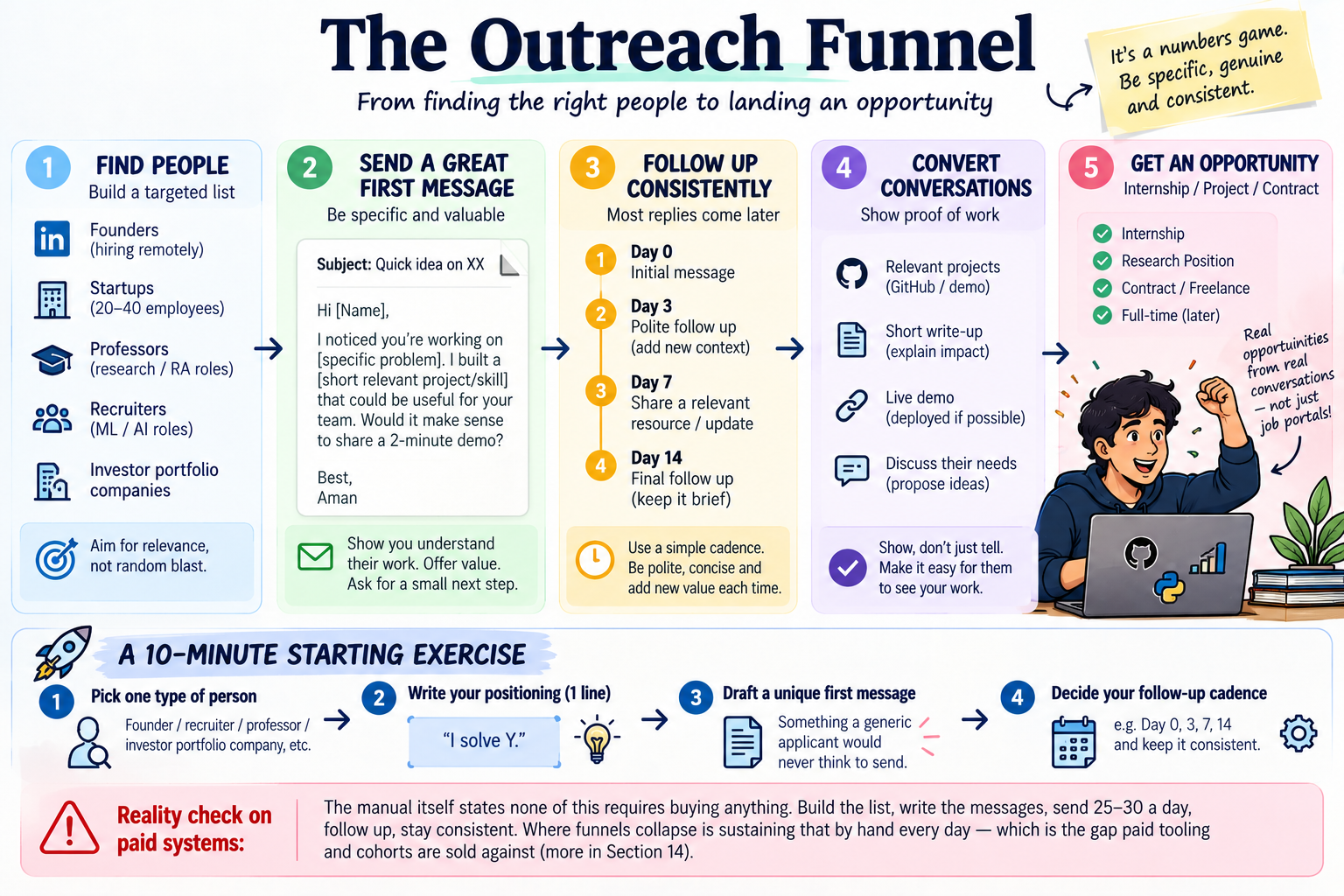
- Find the right people. Define your Ideal Customer Profile (if hunting clients) or Ideal Recruiter Profile (if hunting a job), and reach out only to people who have the need. Messaging someone who isn’t hiring for your role isn’t outreach — it’s noise.
- Engineer the message. Your prospect gets hundreds of messages a month. A persuasive one doesn’t beg; it breaks the pattern: break the expectation (don’t open with “I’d love to connect”), position as premium, be the individual, not the agency, lead with depth (real expertise, not buzzwords), and follow up until a yes or a no.
- Send consistent signals. In the cited cases, the people who landed contracts sent roughly 25–30 outreaches every single day, week after week — not a burst, not a mood, a steady signal. Consistency keeps N high and stops any variable from quietly drifting to zero.
3.5 Distribution Beats Skill
The manual’s blunt version: Opportunities = Skill × Distribution. A zero in either term zeroes the result. A brilliant engineer nobody knows is 100 × 0 = 0; an average one with real distribution is 70 × 50 = 3,500. It isn’t fair, but it’s math you can change — and outreach compounds, because every accepted connection quietly becomes part of the audience that later sees your posts.
3.6 The Complete Model: Three Trust Multipliers
The six variables generate conversations. Three more multipliers make every message land harder:
O = N × A × R × P × C × V × L × S × M
- L — LinkedIn Authority (amplification): every campaign creates profile visits and content views; people who never reply still read, remember, and warm up.
- S — Social Proof (trust): projects, GitHub, a portfolio, case studies, public work. When a prospect visits your profile and sees proof, replies climb across the entire funnel.
- M — Market Positioning: “Looking for an ML role” is a request. “I help startups deploy ML systems” is a solution. Position yourself as a problem-solver and you stop competing on availability and start competing on value. The old model was learn → apply → wait. The new one is learn → build proof → build distribution → create conversations → choose your opportunities. The next sections build each term in order: proof (S) in Sections 4–5, authority and positioning (L and M) in Section 6, and the mechanics of N, A, R, P, C, V in Sections 7–10.
3.7 A 10-Minute Starting Exercise
The manual is explicit that the hardest part is the first message, so before moving on: pick one type of person you want in front of; write your positioning in one line (“I solve Y,” not “I’m looking for X”); draft a message a generic applicant would never think to send; and decide your follow-up cadence.
Reality check on paid systems: The manual itself states none of this requires buying anything. Build the list, write the messages, send 25–30 a day, follow up, stay consistent. Where funnels collapse is sustaining that by hand every day — which is the gap paid tooling and cohorts are sold against (more in Section 14).
4. Proof-of-Work, Part 1: Production-Grade Projects
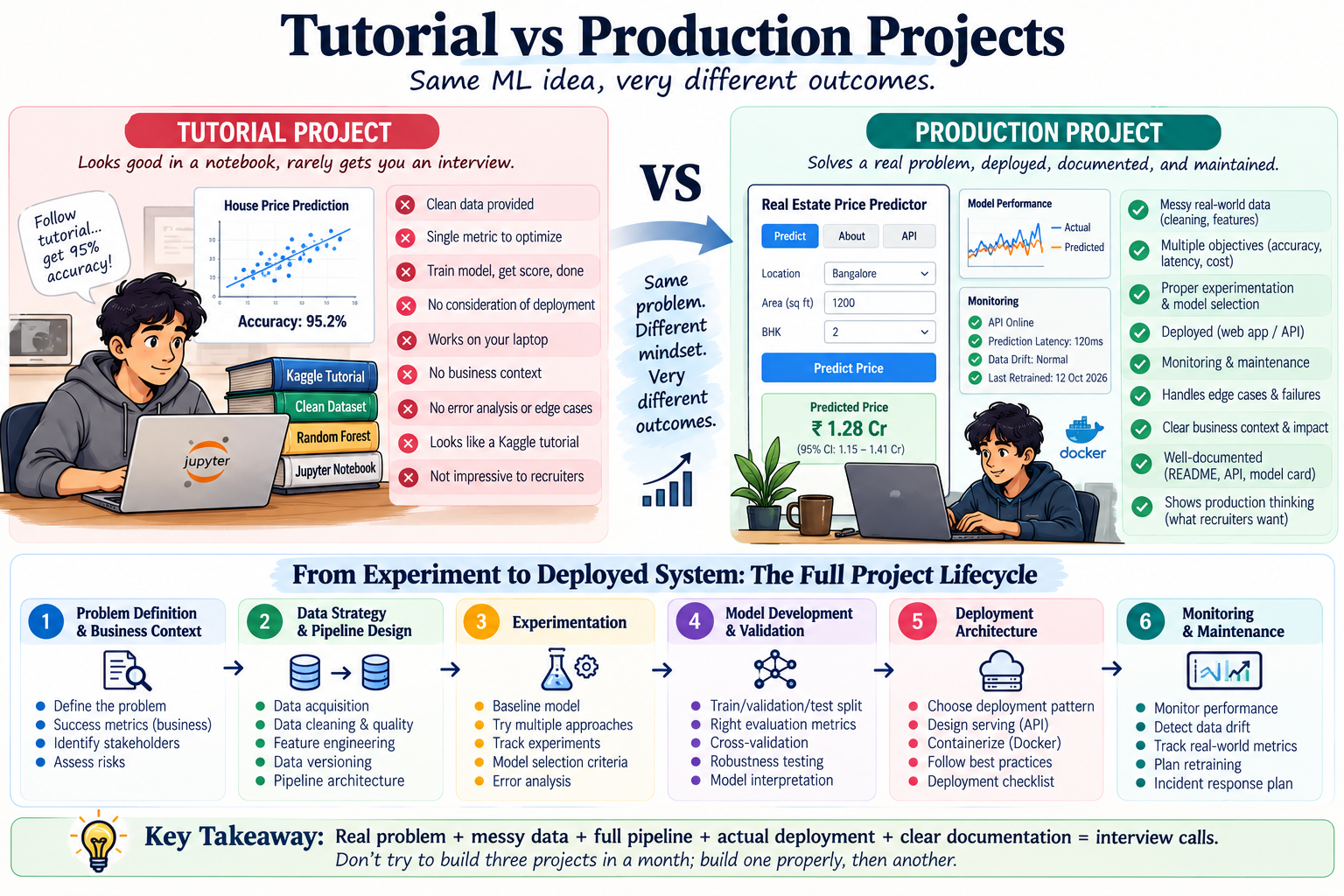
This is the S (Social Proof) term in the equation. Both sources behind this section make the same point from different angles: deployment alone doesn’t make a project production-grade, and the gap between a tutorial project and a production one is exactly what recruiters and founders are screening for.
4.1 Why Projects Get Rejected
Consider the resume line “Built ML model for house price prediction achieving 95% accuracy using Random Forest.” The recruiter’s reaction: skip, next. Hundreds of other resumes say the same thing, and the sentence signals a Kaggle tutorial, no understanding of production systems, and a belief that accuracy is all that matters.
What recruiters actually want is evidence that you can:
- Structure ambiguous problems — define success before building, understand business context, and explain why this needs ML and not a SQL query.
- Build systems that don’t break — think about data changes, edge cases, failures, and what happens when predictions are wrong.
- Make technical decisions — justify this model over the others you tried and weigh complexity against maintainability.
- Communicate impact — which business metric improved, by how much, at what running cost.
Tutorial project Production project Clean data provided Messy data you have to deal with Single metric to optimize Multiple competing objectives Train model, get score, done Ongoing iteration and improvement No consideration of deployment Deployment is half the work Works on your laptop Works reliably at scale
4.2 Choosing Problems That Prove You Can Think
The guide’s three rules for picking a project:
- Real problems only. Stop with Titanic, Iris, MNIST, and clean Kaggle datasets. A real problem has data-quality issues, articulable business value, a deployment scenario that constrains your choices, and ongoing maintenance needs.
- Production complexity required. The project should force hard decisions — missing data, imbalance or distribution shift, feature engineering from raw data, latency constraints, monitoring.
- Clear business context. Know the baseline (if you can’t beat a three-line SQL query, don’t use ML), the success metric in business terms, the deployment mode, the cost of failure, and the data refresh strategy. Project categories that work: local business problems (demand forecasting for restaurants, churn prediction for gyms), personal pain points (a job-application tracker, an expense categorizer), recreating real systems (a recommendation or trend-detection feature from a major product), and domain-specific applications (healthcare, finance, e-commerce).
Before committing, check data accessibility, scope (finishable in 2–4 weeks — one well-done project beats five half-finished ones), demonstrability (explainable to a recruiter in two minutes), learning value, and portfolio fit.
4.3 From Experiment to Deployed, Monitored System
The guide lays out the full lifecycle as six phases, each with concrete steps:
| Phase | What you do |
|---|---|
| 1. Problem definition & business context | Write a project brief, define a success-metrics hierarchy, identify stakeholders, assess risks |
| 2. Data strategy & pipeline design | Acquisition strategy, data-quality framework, data versioning, feature engineering, pipeline architecture |
| 3. Experimentation | Establish a baseline, run hypothesis-driven experiments, track them, define model-selection criteria, do error analysis |
| 4. Model development & validation | Sound train/validation/test splits, the right evaluation metrics, rigorous cross-validation, robustness testing, interpretation |
| 5. Deployment architecture | Pick a deployment pattern, design serving, follow API best practices, containerize, run a deployment checklist |
| 6. Monitoring & maintenance | Decide what to monitor, detect data drift, track performance, plan retraining, write an incident-response plan |
4.4 Documentation and the Demo That Gets You Called Back
Your README is your elevator pitch. In two minutes it should answer: What problem does this solve? Why should I care? What makes this impressive? Can this person build production systems? The recommended structure runs from a 30-second hook (what it is, the business problem, headline numbers) through problem definition, technical approach, results (including baseline comparison and honest limitations), how to run it in under five minutes, project structure, and future improvements. Extra documentation worth having: API docs, a deployment guide, a model card, data documentation, and an experiment log.
For demos, the guide recommends deploying somewhere a recruiter can click and try — Streamlit Cloud, Hugging Face Spaces, Railway/Heroku-style hosts, or a FastAPI service with interactive Swagger docs — with pre-filled example inputs, clear feedback, graceful handling of edge cases, and a load time under about five seconds. A short screen-recorded walkthrough is the fallback when a live demo isn’t possible.
How you present the project matters as much as the build. Don’t just publish the finished app — document the engineering: the problem, the architecture and decisions, where AI was used versus where you exercised your own judgment, one failure or limitation, how you diagnosed and fixed it, and evidence that the improved version works.
4.5 Time, Realistically
| Template | Time |
|---|---|
| End-to-end prediction pipeline (full lifecycle) | 3–4 weeks |
| Real-time serving API (low-latency) | 2–3 weeks |
| Domain-specific application (industry specialization) | 3–4 weeks |
Key takeaway: Real problem + messy data + full pipeline + actual deployment + clear documentation = interview calls. Don’t try to build three projects in a month; build one properly, then another. The guide also includes an appendix of 15 fatal mistakes in ML projects — the recurring pattern is that bad projects demonstrate tutorial-following, and good projects demonstrate production thinking.
5. Proof-of-Work, Part 2: Open-Source Contributions
A production project proves you can build something end to end. Open source proves something different: that you can work inside someone else’s codebase, collaborate with maintainers, and ship real, merged changes. The sources argue the two are stronger together than either alone.
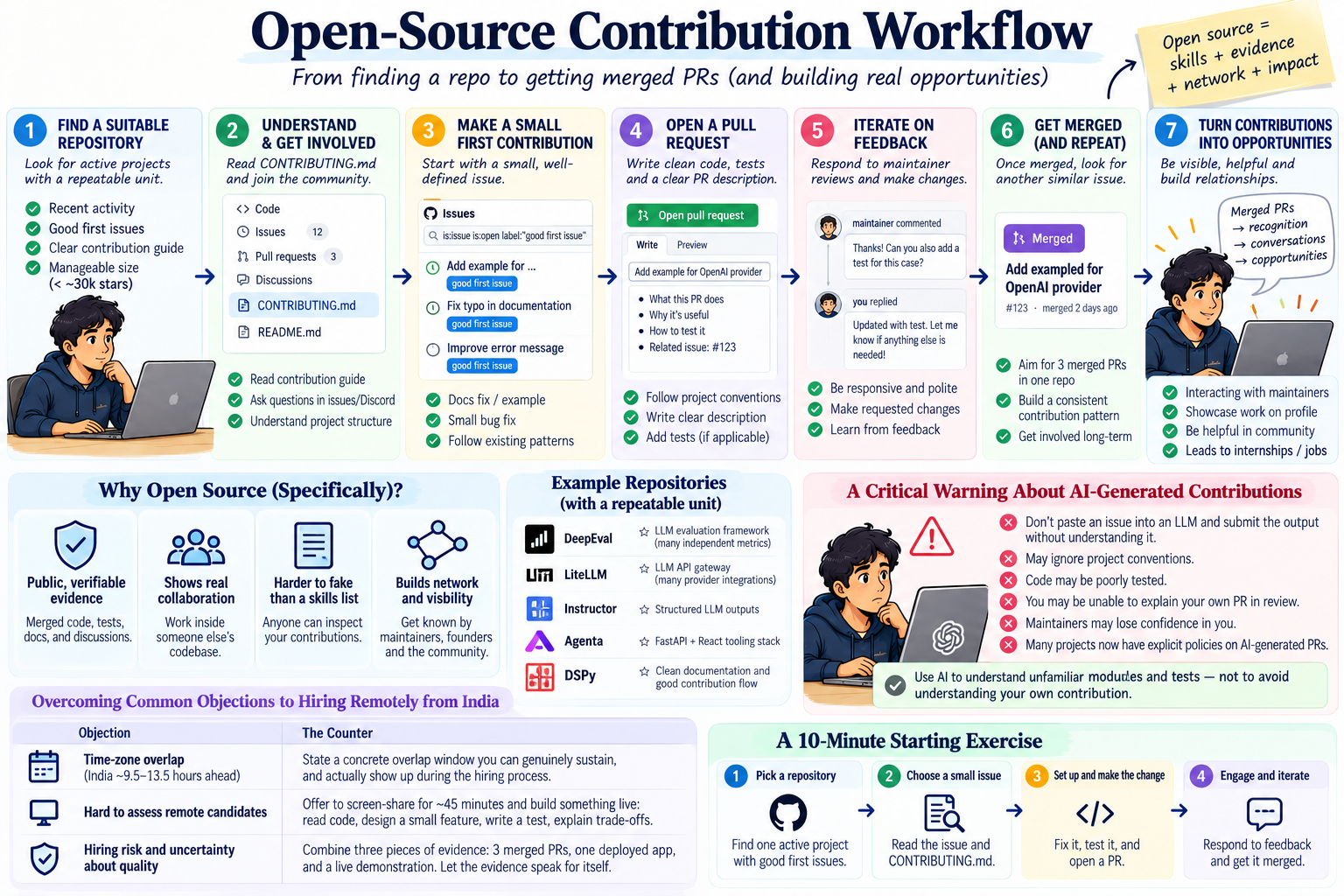
5.1 Why Open Source, Specifically
Junior roles increasingly ask for roughly two years of experience, and AI coding tools let experienced engineers absorb work that used to go to juniors. A resume claiming “Python, ML, APIs, LLMs” is easy to write and hard to verify. The fix is to replace unsupported claims with publicly inspectable evidence: merged contributions, a deployed app, tests, documentation, and a live demonstration of how you think.
5.2 Choosing the Right Repository: The Repeatable-Unit Principle
Generic “contribute to open source” advice fails beginners because a huge repository with thousands of open issues produces weeks of confusion. The guide’s fix: look for projects built from a repeatable unit — a small component you can implement by following an established pattern. Once you understand one unit, the next follows the same shape, which makes your second and third contributions dramatically faster.
Examples cited in the sources (not a required list, and their star counts aren’t independently verified): DeepEval (an LLM evaluation framework with dozens of independent metrics), LiteLLM (an LLM API gateway with a very large number of provider integrations), Instructor (structured LLM outputs), Agenta (a FastAPI + React tooling stack), and DSPy (noted for clean documentation).
Four criteria for choosing: recent activity (commits within the last week), genuine “good first issue” labels, real contribution documentation (CONTRIBUTING.md), and a manageable maintainer workload. As a rough heuristic on size, repositories below ~30,000 stars tend to have more accessible maintainers, while above ~100,000 stars pull requests may sit in a long queue — though community culture matters more than star count alone.
5.3 The Exact Process for Getting Contributions Merged
- Read CONTRIBUTING.md first. Many rejected PRs fail here, even when the code is fine.
- Join the community before submitting code. Introduce yourself, ask focused questions, and learn maintainer expectations.
- Make the first contribution small and boring — a docs fix, a missing example, a small reproducible bug.
- Repeat the same contribution pattern, implementing another unit of the same type.
- Aim for three merged PRs in one recognizable repository. Sustained involvement beats scattered participation. Plan for several weeks to get the first PR merged. And keep the distinction clear: a submitted PR is not proof the project accepted your work — a merged one is.
A critical warning about AI-generated contributions: Do not paste a GitHub issue into an LLM and submit the output without understanding it. The solution may ignore the project’s conventions, the code may be poorly tested, you may be unable to explain your own PR in review, and maintainers may lose confidence in you entirely. Several major projects already have explicit public policies on AI-generated PRs. The caution isn’t about using AI — use it to explain unfamiliar modules and tests — it’s about using AI to avoid understanding your own contribution.
5.4 Open Source as a Networking Strategy
One source claims roughly 58% of hires across a set of AI-startup founding-engineer searches came through founders’ prior networks. The underlying study isn’t provided, so I treat it as a claim from one video rather than a verified statistic. The mechanism, though, holds up regardless of the exact percentage: merged work gives maintainers a reason to recognize your name, puts you inside communities where AI-startup people hang out, creates a public artifact a founder can inspect, and builds a relationship before you ask for anything.
5.5 Overcoming the Three Objections to Hiring Remotely from India
| Objection | The counter |
|---|---|
| Time-zone overlap (India is roughly 9.5–13.5 hours ahead of the US) | State a concrete overlap window you can genuinely sustain, calculated for that company and season — and actually show up in that window during the hiring process. |
| Founders can’t easily assess remote candidates | Offer to screen-share for about 45 minutes and build something live: read unfamiliar code, ask clarifying questions, design a small feature, write a test, explain trade-offs aloud. Agree on scope up front — don’t let it become open-ended unpaid work. |
| Hiring risk and uncertainty about quality | Combine all three pieces of evidence: three merged PRs in a recognizable repo, one genuinely deployed end-to-end app, and a willingness to demonstrate live. Each addresses a different uncertainty — collaboration, ownership, and real-time thinking. |
The underlying strategy: don’t argue that you’re a good candidate — give the employer evidence that lets them reach that conclusion themselves.
6. Packaging Your Proof: Positioning and LinkedIn
This section builds the L (LinkedIn Authority) and M (Market Positioning) multipliers from Section 3.
6.1 Treat Yourself as a Product, and Hiring as a Sale
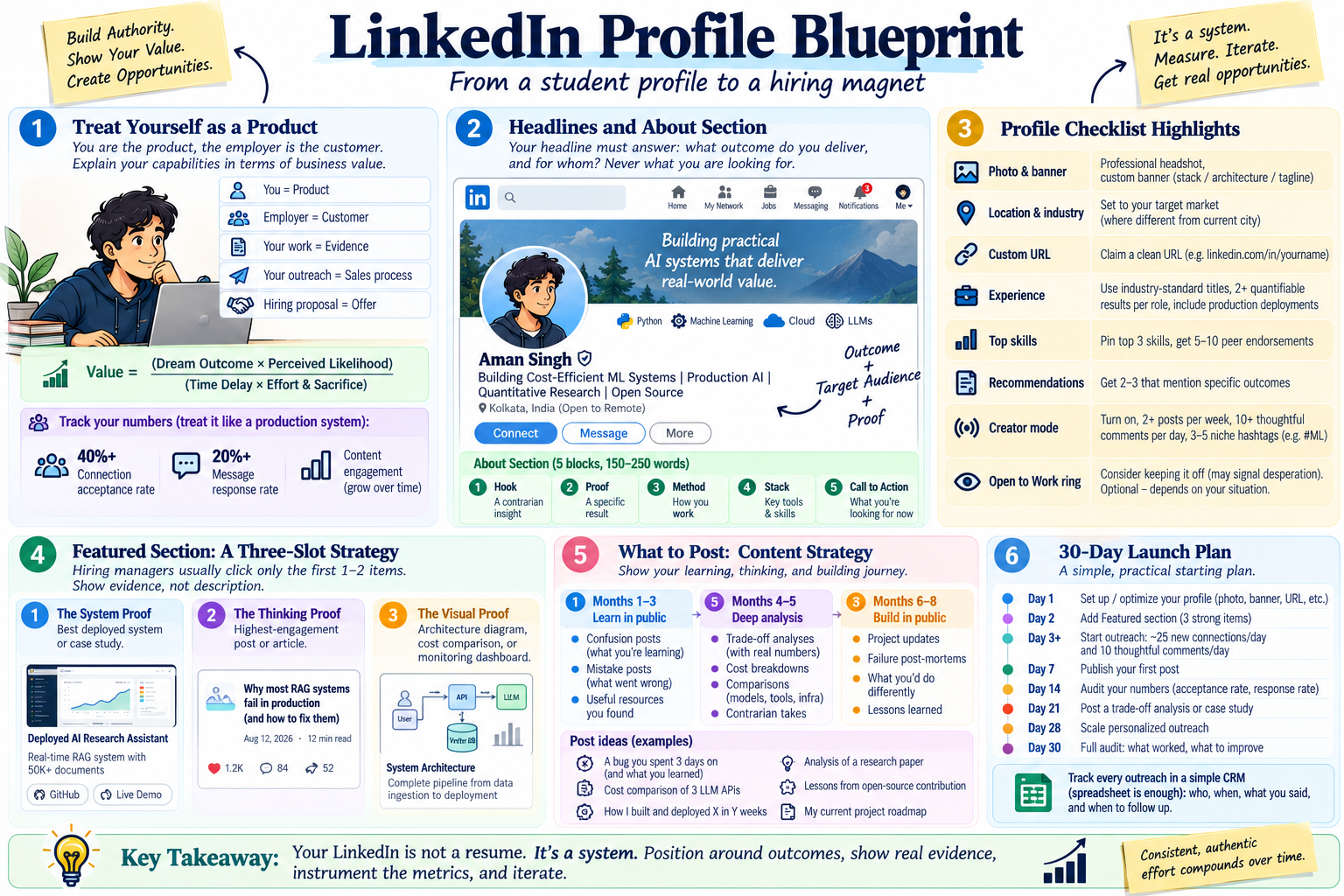
The core framing: an engineer seeking employment is like a software company selling a subscription. You are the product, the employer is the customer, your work is the evidence, your outreach is the sales process, and your hiring proposal is the offer. The goal isn’t exaggeration — it’s explaining genuine capabilities in terms a business cares about.
The toolkit offers a value equation: Value = (Dream Outcome × Perceived Likelihood) ÷ (Time Delay × Effort & Sacrifice). Every section of your profile has one job: raise perceived likelihood (they believe you can deliver) and cut time delay (you can contribute immediately). Then treat the profile like a production system — instrument it and iterate. Track connection-acceptance rate (target 40%+), message response rate (target 20%+), and content engagement. If the numbers are low, the messaging needs work, not more applications.
Position around outcomes, not attributes. “AI enthusiast, passionate about machine learning, looking for opportunities” lists what you like. “I build cost-efficient ML systems and evaluate their production reliability” explains the value you offer — as long as it’s true and, ideally, backed by a concrete result.
6.2 Headlines and the About Section
Your headline is the most important line on LinkedIn: it appears in search, connection requests, comments, and messages, and you have about three seconds. It must answer what outcome do you deliver, and for whom? — never what are you looking for. The guide provides a library of headline formulas (outcome + proof, before → after, and a dozen more).
The About section is a pitch, not a biography, built from five blocks in 150–250 words: a hook (a contrarian insight about a problem your audience cares about), the proof (a specific, measurable example), the method, the stack, and a call to action.
6.3 Profile Checklist Highlights
- Photo and banner: professional headshot, clear face, neutral background; a custom banner showing your stack, an architecture diagram, or a value-proposition tagline.
- Location and industry: set them to your target market where they differ from your current city, since recruiters filter by location.
- Custom URL: claim a clean one, without random numbers.
- Experience: use industry-standard titles, include at least two quantifiable results per role, and list production deployments as real experience entries.
- Top three skills pinned, 5–10 peer endorsements, and 2–3 recommendations that mention specific outcomes.
- Creator mode on, 2+ posts per week, 10+ thoughtful comments per day, and 3–5 niche hashtags rather than broad ones like #AI. (One tip in the guide — turning off the green “Open to Work” ring because it may signal desperation — is the source’s opinion, and plenty of people disagree. I’d treat it as optional.)
6.4 The Featured Section: A Three-Slot Strategy
Hiring managers typically click only the first one or two items, so every slot must show evidence, not description:
- The System Proof — your best deployed system or case study, with measurable outcomes (a repo with an excellent README, or a write-up with before/after metrics).
- The Thinking Proof — your highest-engagement post or article: a trade-off analysis, a failure story, or a data-backed contrarian take.
- The Visual Proof — an architecture diagram, a cost-comparison document, or a monitoring-dashboard screenshot.
6.5 What to Post, and the 30-Day Launch Plan
The content calendar maps to three phases. In months 1–3, post “confusion posts” (what you’re learning and where it tripped you up) and “mistake posts” (like discovering data leakage in a model you thought was great). In months 4–5, post trade-off analyses and cost breakdowns with real numbers. In months 6–8, build in public and write failure post-mortems.
The 30-day plan is a daily rhythm: set up your profile (day 1), add the Featured section (day 2), start outreach — about 25 new connections and 10 comments a day — from day 3, publish a first post on day 7, audit your numbers on day 14, post a trade-off analysis in week 3, start drafting a case study on day 21, scale personalized outreach in week 4, and run a full audit on day 30. And always: track every outreach in a simple CRM (even a spreadsheet) — who, when, what you said, and when to follow up.
Key takeaway: Your LinkedIn is not a resume. It’s a system. Instrument it, measure it, iterate.
7. Direct Outreach to Startup Founders: The Step-by-Step Process
This is the most tactical part of the guide. It operationalizes N, A, R, P, C, and V.
7.1 Step 1 — Identify Relevant Funded Startups
Look for companies that recently raised funding and have a product or problem matching your skills. Favor small teams where founders are accessible. Practical criteria: a relevant technical need, skill alignment, a useful improvement you can identify, a reachable decision-maker, and hiring arrangements compatible with your location.
Reality check: No single verified database hands you this list. Build it deliberately from funding announcements (Crunchbase, TechCrunch, sector newsletters), LinkedIn filters, and niche job boards. If you get a pre-built leads list, treat it as a starting point to filter for relevance — not a list to spray messages at. Untargeted volume is exactly what collapses A and R toward zero.
7.2 Step 2 — Research Before You Contact
Find a specific, genuine reason to write: a recent product launch, an AI workflow they run, an identifiable technical bottleneck. Connect your message to a real business problem rather than a generic request for employment.
7.3 Step 3 — Provide Value Before Asking for a Job
This is the main differentiator. “Hi, I’m looking for opportunities in ML engineering — can we connect?” describes what you want without giving the founder a reason to respond. The alternative: identify something useful you could build or improve — a prototype for routing support tickets, a demo of an AI feature relevant to their product, a small workflow improvement — and make the link to their needs immediately obvious.
7.4 Step 4 — Use a Small, Specific Call to Action
Offer a prototype, or propose building one within roughly 48 hours. Ask whether a small demonstration would be useful instead of asking for a formal interview. The shape of the message is: I noticed [Company] is working on [specific feature]; I’ve been exploring how [workflow] could be improved using [approach]; I have an idea for a small prototype that could help with [plausible benefit] — would this be useful to your team?
7.5 Why Prototypes Help — and What They Cost
The reciprocity principle: when you invest time understanding a company and build something relevant, the founder has more evidence than a resume provides. The sequence is research → build a useful prototype → contact the founder → discuss. A prototype must never expose confidential information, copy proprietary functionality, or be treated as entitlement to a job.
Reality check: Building a bespoke prototype for every company burns time. A more efficient pattern is to build one strong, reusable project (Section 4), adapt its demo for each company, and build a bespoke prototype only after a genuinely promising opportunity appears.
Combine channels — LinkedIn, email, X, public technical posts — so you become recognizable, but keep it spaced and respectful. And size the funnel realistically: the guide’s illustrative example is 800 people contacted → 40 conversations → 4 interested → 1 hire (about 0.125% overall). It’s a hypothetical from one speaker, not an industry rate. Quality lifts every multiplier at once; raw volume lifts only N.
8. Cold Email Fundamentals
Several independent sources, aimed at different audiences, converge on remarkably similar principles.
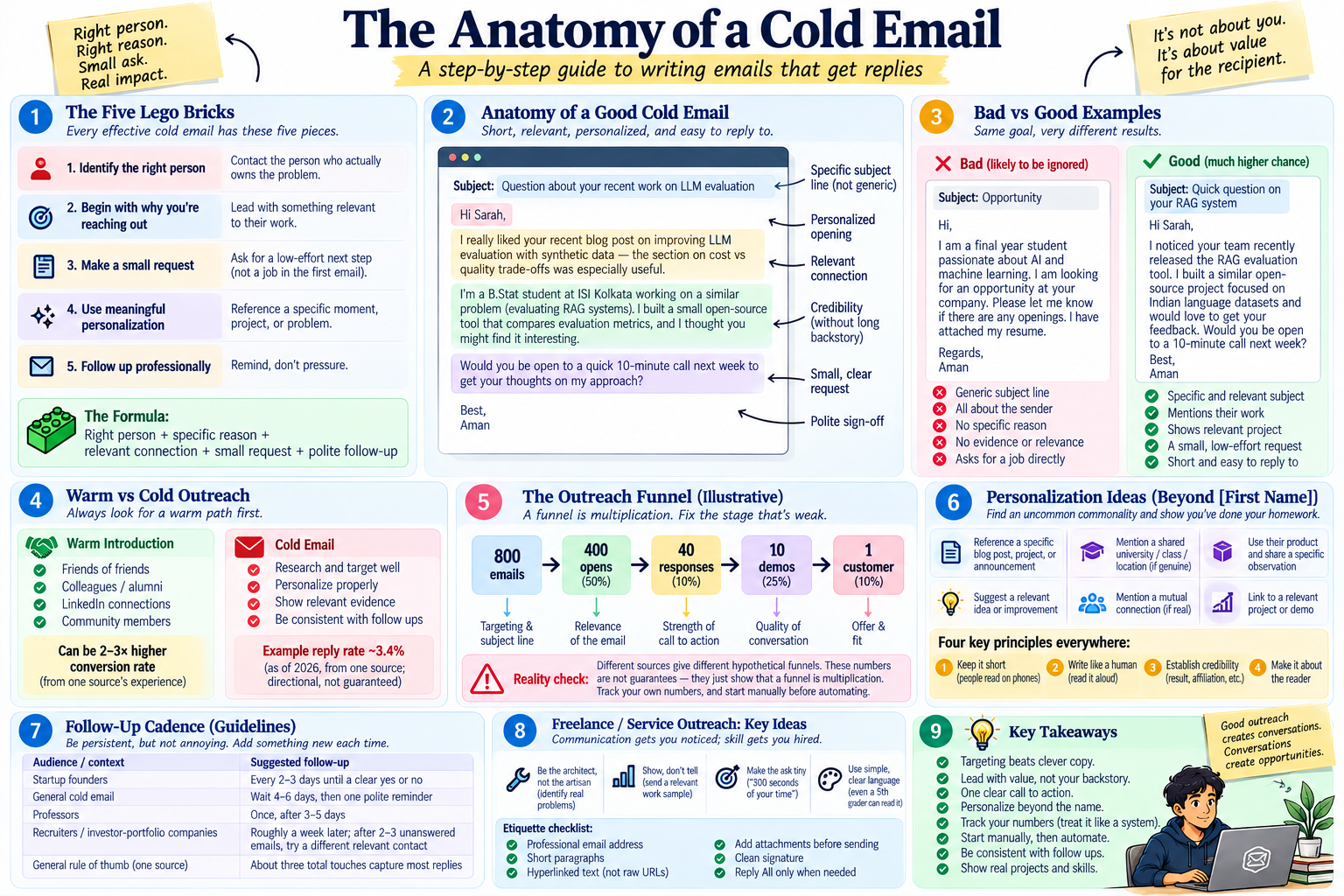
8.1 The Five Lego Bricks
| Brick | What it fixes |
|---|---|
| 1. Identify the right person | Don’t email info@company.com; find whoever actually owns the problem (a data lead for data roles, etc.) |
| 2. Begin with why you’re reaching out | Don’t open with your backstory — lead with something relevant to their world |
| 3. Make a small request | Don’t ask for a job, referral, or meeting in message one (“proposing marriage on a first date”) |
| 4. Use meaningful personalization | A generic compliment could go to hundreds of people; reference a specific moment or problem |
| 5. Follow up professionally | Remind, don’t pressure |
The formula: right person + specific reason + relevant connection + small request + polite follow-up.
8.2 The Biggest Mistake: Making It About Yourself
“I am looking for an opportunity at your company” becomes “I noticed your team is expanding its data capabilities.” “I have always been passionate about AI” becomes “I noticed your team is building AI-powered products.” The recipient should understand three things fast: why you contacted them, why it’s relevant to their work, and how they can respond with minimal effort.
8.3 Warm Introductions Beat Cold Email
Before writing a single cold email, check for a warm path: friends of friends, colleagues, LinkedIn connections, alumni networks. One source cites warm intros converting at 2–3× the rate of cold email — the speaker’s own experience, not a guaranteed multiplier.
8.4 Build the Funnel Before You Send Anything
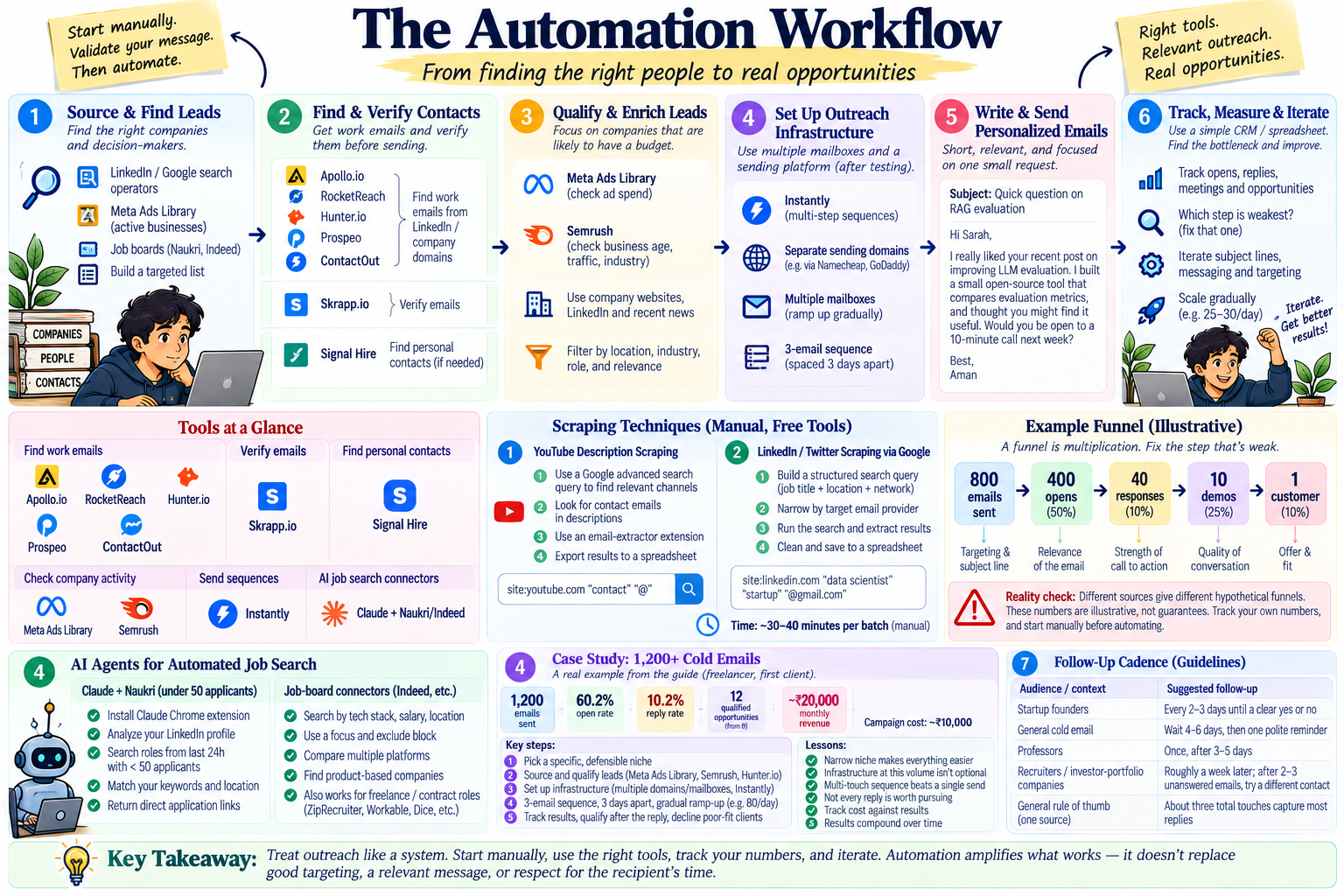
Start from the outcome you want and work backward. One illustrative B2B funnel: 800 emails → 400 opens (50%) → 40 responses (10%) → 10 demos (25%) → 1 customer (10%). The funnel also tells you where to fix things: few opens points at targeting and subject lines; opens but no replies points at relevance; replies but no meetings points at your call to action; meetings but no conversions points at the offer itself.
Reality check: This guide contains three different hypothetical funnels (Sections 3, 7, and this one), from different sources and contexts. They aren’t meant to be averaged — each just illustrates that a funnel is multiplication. Track your own numbers. And start manually: before automating anything, you don’t yet know which subject lines work or which prospects respond.
8.5 Targeting Beats Clever Copy
A hundred carefully researched emails to companies with a clear reason to care will usually beat a thousand generic ones. Use your personal name as the sender, keep subject lines short and natural-sounding, and remember that email often outperforms LinkedIn DMs for cold outreach — though it varies by recipient. One source cites an average cold-email reply rate of about 3.4% as of 2026; treat that as directional, since at that rate 1,000 emails yields roughly 34 replies, not 34 interviews.
8.6 Personalize Beyond the Name
Inserting [First Name] isn’t personalization. The strongest version finds an uncommon commonality — attending the same university and taking classes in the same building, using the same product for years, a feature you genuinely appreciate. Sharing a nationality or gender rarely counts. Four more principles recur everywhere: keep it short (people read on phones), write like a human (read it aloud; if it’s awkward to say, rewrite it), establish credibility (a relevant affiliation, result, or mutual connection), and make it about the reader.
8.7 One Clear Call to Action
Every email needs exactly one specific, low-effort next step, in its own sentence near the end. “Please review our 30-page document” asks too much; “Would you be open to a 10-minute conversation about how your team handles this?” can be answered on the spot. Trying to get a meeting and an introduction and feedback at once leaves the recipient with too many decisions — and they act on none of them.
8.8 Learning from Real Examples
Three emails that failed: a pitch for the wrong product sent to a company with no need for it (no writing quality fixes a targeting mismatch); a vague ask with an opt-out line that made it feel like a mass campaign; and an all-about-the-sender message — “I am… I have… I can…” — with no reason for the reader to care.
Three that worked: the uncommon-commonality email (a shared university detail, credibility, respect for the reader’s time, and one specific ask); a mostly-templated “special invitation” that still felt personal through informal language and exclusivity; and a reframed pitch that turned “help our startup hit its goals” into “we’ll throw your whole office a free smoothie party.” The lesson is that templates aren’t inherently impersonal — generic and irrelevant is the problem.
8.9 Freelance and Service Outreach: Skill Comes First
A related framework aimed at freelancers adds ideas worth carrying into any outreach:
- Beware the “entitled freelancer” — expecting work without the underlying skill. Knowing Photoshop isn’t the same as knowing visual design. Picture three concentric circles: all freelancers emailing; those whose subject line and professionalism get them noticed; and the smallest circle, those who combine communication and the actual skill. Communication gets you noticed; skill gets you hired.
- Be the architect, not the artisan. An artisan executes a specified design; an architect decides what should be built and why. “I know Photoshop and Canva” is the artisan. “I noticed your recent posts have inconsistent visual hierarchy — I prepared an alternative carousel” is the architect.
- The two-plumbers analogy: one fixes the leak and quotes a price; the other notices the pipe is old and recommends replacing it. Diagnose the underlying problem — but only when the observation is genuinely specific, not a guess dressed up as insight.
- Show, don’t tell. If you’re a beginner, say so plainly and lead with projects and practice work; either way, a short work sample built for this recipient beats any claim.
- Make the ask tiny (“all I need is 300 seconds of your time”), invoke only genuine referrals, and don’t force every email into one mechanical shape — polish supports substance, it doesn’t replace it.
- Etiquette checklist: professional email address, clean signature, short paragraphs, hyperlinked text instead of raw URLs, attachments added before filling in the recipient, and Reply All only when everyone truly needs it.
- Additions from Ankur Warikoo: a curiosity-driven subject line, language simple enough for a fifth-grader, and your purpose and ask within the first few lines.
8.10 Following Up Without Becoming Annoying
Different sources recommend different cadences, which tells me the right answer depends on who you’re writing to:
| Audience / context | Suggested follow-up |
|---|---|
| Startup founders (outreach framework) | Every 2–3 days until a clear yes or no |
| General cold email | Wait 4–6 days, then one polite reminder |
| Professors | Once, after 3–5 days |
| Recruiters / investor-portfolio companies | Roughly a week later; after 2–3 unanswered emails, try a different relevant contact |
| One source’s rule of thumb | About three total touches capture most replies |
Whatever you choose: make each follow-up add something new, stop immediately if someone declines, and don’t let persistence curdle into pressure. If you have nothing new to add, it’s fine to let a thread go quiet and revisit in a few months.
9. Templates by Audience
The principles apply everywhere, but the right template depends on who you’re writing to. These are condensed structures; always rewrite them in your own voice with a real, researched reason to write.
9.1 Emailing Professors for Research Positions
Two independent sources agree on the rules: keep it to roughly 150–180 words; reference the professor’s actual recent work (a specific paper, not a generic compliment); offer to contribute rather than asking for guidance; send from your institutional email; avoid AI-sounding language; stay flexible about small or even unpaid tasks at first; follow up once after 3–5 days; and contact 7–10 professors, prioritizing one per research group rather than mass-emailing a department. One source suggests sending Tuesday–Thursday, 2–5 PM.
Structure: introduction (name, year, department, university, purpose) → research interest (why this professor — it requires reading two or three of their recent papers) → brief experience → a call to action proposing a short virtual meeting.
9.2 Emailing Recruiters: Be Interested, Not Interesting
Borrowing from Dale Carnegie: a weak cold email tries to impress the recruiter with your achievements; a strong one shows genuine curiosity about their experience and asks a thoughtful, open-ended question.
Finding them: open the company’s LinkedIn page → People section → search “Talent Acquisition,” “HR,” “Recruiting,” or “Early Talent” → apply location and function filters → inspect profiles for recruiters who posted similar roles. If you can’t find the exact recruiter, one for the relevant department is a reasonable fallback.
Three rules of personalization: be genuinely curious (recruiters can tell when you aren’t); ask an open-ended question (nothing answerable with yes/no); make the question unique to the person (if it could go unchanged to every recruiter at the company, it needs more work). A good ask is a brief 15-minute coffee chat. Avoid vague subject lines (“Hello”) and exaggerated ones (“Urgent Opportunity”). One cited recommendation is Tuesday morning, 8–10 AM in the recipient’s local time — a starting point to test, not a law.
9.3 Sourcing Companies from Investor Portfolios
Instead of searching job boards, start from investor portfolios — VCs have already done diligence, so their portfolio pages are a pre-filtered company list. Directories cited include Y Combinator’s job listings, Sequoia Capital India’s company list, Rainmatter, Kalaari Capital, and Better Capital. For each company, check that its product and likely hiring needs genuinely match your skills before adding it to your list.
Six principles for the email itself: keep it short; write a strong, informative subject line (a specific descriptor beats “Quick Question”); demonstrate proof of work (a short Loom video, a portfolio, a GitHub repo, or a deployed demo); mention real, inspectable accomplishments rather than “I’m passionate about ML”; state a timeline only if it’s genuine (never invent urgency); and include a clear call to action.
The guide gives four template shapes: (A) direct outreach for a full-time role, (B) highlighting skills and company alignment, (C) demonstrating initiative through a project link, and (D) contacting an alumnus for a 15-minute coffee chat.
A/B test one variable at a time — subject line, call to action, project evidence, or personalization depth — and don’t draw conclusions from a handful of emails. An open rate, a reply rate, and an interview rate are three different things.
9.4 Internship Outreach: A Seven-Part Template
This one is built for students without a Tier-1-college pedigree or much formal experience, and it’s designed to turn circumstances into a positive narrative rather than an apology:
- Greeting — address the recipient politely by name.
- Introduction — name, institution, degree, current year.
- Internship interest — why this company, your preferred domain, while staying open to other domains the team finds a fit for.
- Relevant experience — one significant internship, research, or project. If you have none, use a strong academic project or independent experiment; never invent experience.
- Leadership and achievements — positions of responsibility, competitions, initiatives.
- Personal motivation — why this matters to you; if you address a non-Tier-1 background, frame it around what you’ve done in response, not as an excuse.
- Request and closing — express interest in discussing a contribution; mention your attached resume; add LinkedIn and a phone number. Who to contact: don’t default to HR. Someone working directly in your target department often understands the role better — though some organizations, like certain consulting firms, run centralized recruiting where HR is genuinely the right door. Use LinkedIn alongside email, prioritize 2nd-degree connections (a mutual contact can introduce you), and build connections before you urgently need an internship.
The common mistakes list is short and brutal: identical messages to everyone, contacting only HR, writing too much about yourself, making a non-Tier-1 background the main story, being too rigid about role preference, vague requests with no next step, waiting until you’re desperate, and forgetting a working resume link and contact details.
10. Automating the Outreach Machine
Finding the right person and their contact details is a mechanical bottleneck in every method above — and sustaining 25–30 outreaches a day by hand is where most funnels collapse. This section is the automation toolkit, with one rule up front: start manually first, and automate only once you understand what works.
10.1 Email and Contact-Finding Tools
| You need to… | Tools cited |
|---|---|
| Find a specific person’s work email from their LinkedIn profile | Apollo.io, Prospeo, RocketReach, Hunter.io, ContactOut |
| Verify an email before sending | Skrapp.io |
| Find a personal contact when no professional one exists | Signal Hire |
| Explore a company’s email format (firstname.lastname@…) | Hunter.io, Apollo.io (a guessed address is not a verified one) |
| Build large lead lists from public descriptions and profiles | Google search operators + an email-extractor Chrome extension |
| Check whether a company has marketing budget or activity | Meta Ads Library, Semrush |
| Run multi-step sequences at scale | Instantly |
| Automated local job scanning, CV scoring, and ATS tailoring | career-ops (local CLI multi-agent system) |
| Search job boards against your own profile automatically | Claude with a Naukri or Indeed connector |
Reality check on etiquette: Confirm the address belongs to the right person and company; prefer contact details clearly intended for business communication; never mass-spam or repeatedly contact someone who asked you to stop; and don’t use personal details obtained through inappropriate means. The tools exist to make relevant outreach possible, not to bypass anyone’s reasonable privacy. (My own addition: also check the anti-spam and data-protection rules that apply in the recipient’s country before sending at volume.)
10.2 Scraping Techniques for Bigger Lead Lists
Two manual workflows built from free tools: YouTube description scraping (a Google advanced-search query that surfaces channels listing a contact email in their description, then an email-extractor extension to export the results to a spreadsheet) and LinkedIn/Twitter scraping via Google search (build a structured query from a network, job title, and location, narrow it by a target email provider, run it, and paste the results page into an extractor to produce a clean address list). The source estimates 30–40 minutes of work per batch. The same etiquette rules apply even more strongly at this scale: relevance first, respect opt-outs, and a big list is not a license to spam.
10.3 AI Agents for Automated Job Search
Searching job boards manually burns hours that are better spent building proof-of-work or writing targeted founder emails. Here, AI agents can act as personal scouting infrastructure — provided they are used with discernment rather than sprayed recklessly.
10.3.1 career-ops: A Local-First, Open-Source AI Job Search Agent
One of the sharpest implementations of the “engineer your job search” philosophy is career-ops (Documentation & Quick Start), an open-source multi-agent job search tool created by Santiago Fernández de Valderrama Aparicio (Case study: How I Built My Own AI Job Search Tool).
The creator’s founding premise captures the exact asymmetry early-career engineers face:
“Companies use AI to filter candidates. I just gave candidates AI to choose companies.”
Unlike closed SaaS platforms that charge monthly subscriptions and blindly blast generic resumes (often triggering ATS spam filters or getting accounts banned), career-ops is built on a few distinctive architectural principles:
- Runs locally through your own AI coding CLI. It connects directly to whatever AI tool you already use — Claude Code, Cursor, Codex, OpenCode, Copilot, Qwen, Kimi, or free local models. No proprietary cloud lock-in; your CV, notes, and private data never leave your local machine.
- The “Human-in-the-Loop” boundary. The tool has an explicit design motto: “It helps you fill in each application; you press Submit.” It automates the exhausting cognitive overhead — discovery, evaluation, tailoring, and question preparation — while keeping you in full control of quality and judgment before anything is sent.
- 14 operational modes across the lifecycle. The system doesn’t just scrape; it orchestrates a complete candidate pipeline:
- Job Board Scanning: Scans target boards and company career pages across your desired tech stack and locations.
- Multi-Dimensional 1–5 Match Scoring: Scores each listing from 1 to 5 against your specific CV, skills, and preferences before you apply. If an opening scores a 2/5, you don’t waste 45 minutes tailoring materials for a weak fit.
- ATS-Optimized Resumes & Cover Letters: Generates tailored markdown/PDF resumes and cover letters specifically calibrated for the target role’s ATS keywords without fabricating experience.
- Interview Prep Generation: Extracts the technical and domain requirements from the job description to build customized technical interview question banks, system design prompts, and speaking points.
- Application Tracking: Maintains an organized local tracker of application dates, stages, follow-up timelines, and interviewer notes.
In his own case study, the author evaluated 740+ listings using this multi-agent workflow, filtering down to high-signal opportunities and landing a Head of AI role. For anyone seeking remote or international roles from India, this kind of systemized, high-standard filtering is what keeps P (Positive reply rate) and C (Call booking rate) high instead of burning out on low-probability applications.
10.3.2 Browser and Connector-Based Workflows
For lighter, browser-based queries without a full CLI pipeline, two practical setups use an AI assistant with connector access:
- The “under 50 applicants” strategy (Claude + Naukri). Most roles on crowded portals are saturated in the first wave of applicants, so targeting recently posted, lightly applied-to listings improves your odds of being seen. Setup: install the Claude Chrome extension, keep your LinkedIn profile open as a reference, and enable the extension’s permissions. The advanced prompt asks Claude to analyze your LinkedIn skills and experience, then search Naukri for your target role and location, limited to roles posted in the last 24 hours with fewer than 50 applicants and matching your keywords, returning direct application links.
- Job-board connectors (Indeed and others). Use Claude’s connectors to search and filter listings by tech stack, salary, and location, with a comparison view to choose between matches. The prompt pattern has a focus block (stack, country, industry, minimum salary, recency, applicant count, product-based companies) and an exclude block (onsite and hybrid roles, staffing agencies). The same approach extends to freelance and contract roles and to other connectors like ZipRecruiter, Workable, and Dice.
Key takeaway: Treat the exclude block as seriously as the focus block — it’s what keeps the AI from burying good matches under irrelevant ones.
10.4 A Full Case Study: Scaling to 1,200+ Cold Emails
The guide walks through one freelancer’s first-client campaign as a worked example of the infrastructure side of outreach at volume:
- Pick a specific, defensible niche — a narrow service for a narrow type of business, so the pitch, targeting, and proof of work all align.
- Source and qualify leads — use the Meta Ads Library to find businesses actively running paid ads (an imperfect signal of budget), check each with Semrush for business age and search visibility, and find the decision-maker’s email with Hunter.io.
- Set up sending infrastructure — separate sending domains to protect your primary domain’s reputation, multiple mailboxes to distribute volume, a platform like Instantly to schedule sequences and track results, a 3-email sequence spaced 3 days apart, and a conservative ramp-up (starting around 80 emails a day across 4 mailboxes, scaling gradually) because a brand-new mailbox blasting at volume risks spam-filtering.
- Read the results as reported: 1,200 emails sent; a 60.2% open rate; a 10.2% reply rate; 9 qualified opportunities growing to 12; a campaign cost of roughly ₹10,000; and reported monthly revenue of around ₹20,000 from the resulting work.
- Qualify after the reply too. The campaign converted one genuine-fit lead and deliberately declined a poor-fit one. Declining a bad-fit client is a correct decision, not a missed opportunity. The seven lessons: a narrow niche makes everything easier; qualify before and after sending; infrastructure at this volume isn’t optional; a multi-touch sequence beats a single send; not every reply is worth pursuing; track cost against results; and results compound as early clients become case studies for the next round.
Reality check: This is one campaign in one niche with self-reported numbers — not a benchmark. Open-tracking pixels are unreliable, since some email clients block them. Cold-email deliverability rules and platform policies change over time, so verify current best practice before replicating the setup. Running multiple domains and mailboxes carries real cost and real spam-flagging risk, and is worth attempting only after you’ve validated your message and targeting manually.
10.5 The Automation Stack, Summarized
If I put the whole section into a single workflow, it looks like this:
- Build a qualified lead list (source → qualify → find contact).
- Verify emails and keep everything in a tracking sheet or CRM.
- Write a short, personalized 3-touch sequence using Section 8’s principles.
- Send at a conservative daily volume, ramping up gradually.
- Track opens, replies, and qualified conversations — not just sends.
- Review weekly against the equation: which variable is closest to zero? Fix that one.
11. Creating Openings Where No Job Is Posted
One of the most consistent recommendations across all the sources is not to limit your search to companies currently advertising a role. A startup might not have posted an ML-infrastructure job, but a candidate could identify a way to reduce processing costs or improve reliability. If the demonstration is convincing, the founder may connect them with the right team or even create a position around it.
One source cites an anecdote of a student who reportedly landed a remote AI-engineering role at a US company after consistently contacting founders over time. The transcript doesn’t confirm the person’s employment, pay, or whether outreach alone produced the outcome — so I treat it as an illustration that the approach can work, not as a guarantee that it will.
The general lesson connects straight back to the equation: a job-posting-only strategy artificially shrinks N to the companies that happen to be recruiting at the exact moment you’re looking. Widening the aperture to companies with a plausible, demonstrable problem is one of the highest-leverage ways to grow N without lowering message quality.
12. Getting Paid: EOR, Contracting, W-8BEN, and GST
Everything so far is about getting the offer. This short section covers what the sources flag after a US or European company says yes to hiring you from India. None of this is legal or tax advice — treat it as a map of the questions to ask a professional before you sign.
Two ways a foreign company can hire you:
| Arrangement | What it means |
|---|---|
| Employer of Record (EOR) | A third-party service (examples cited: Deel, Remote, Rippling) legally employs you in your country on the company’s behalf, handling compliance, payroll, and often benefits. Closer to a normal job. |
| Independent contractor | You invoice the company directly. No employer–employee relationship; you handle your own tax filing. Simpler for the company, but shifts compliance onto you. |
Which one you get usually isn’t your unilateral choice — but understanding which one you’re in changes your tax filing, protections, and paperwork.
W-8BEN. If a US company hires you as a contractor, you’ll likely be asked for this form, which certifies to the IRS that you’re a foreign person and generally lets the company pay you without default US withholding on US-sourced income. But whether withholding applies — and at what rate — depends on the type of income, any US–India treaty provision, and how the engagement is structured. Filing the form alone doesn’t automatically mean zero US tax exposure.
GST on exported services. Freelance or contract income earned in India for a foreign client is generally treated as an export of services, which can qualify for zero-rated GST — but conditionally: typically payment in convertible foreign exchange, correct invoicing, and (depending on turnover and structure) GST registration or a Letter of Undertaking (LUT). Specifics change with policy updates, so verify with a chartered accountant.
A pre-signing checklist: Am I an employee (via EOR) or a contractor? Will I need a W-8BEN or an equivalent form? How will I invoice, and in what currency? Do I need GST registration or an LUT? Who covers health coverage and paid leave, if anyone? What does the contract say about IP ownership, termination notice, and payment terms?
Key takeaway: None of this should stop you from pursuing opportunities — it’s a short checklist to run once an offer is real. Budget for a brief consultation with a chartered accountant familiar with export-of-services income before your first payment arrives.
13. The 16-Week Implementation Roadmap
The remote-jobs playbook frames the whole effort as a 16-week process across seven phases (the source doesn’t specify exact week-by-week schedules, so these are phases rather than a calendar):
| Phase | Focus | What it involves |
|---|---|---|
| 1 | Build your foundation | Refine positioning around judgment and business value; start a project where AI assists but you make and explain the decisions |
| 2 | Make your work production-oriented | Deploy, test, monitor, examine failure cases, document decisions, prepare demos |
| 3 | Establish your public presence | Update your profile and publish meaningful technical content — progress, problems, failures, measured improvements |
| 4 | Build a target list | Identify funded startups and relevant founders; research products, recent launches, and likely technical needs |
| 5 | Start direct outreach | Lead with a relevant observation or proposed contribution; track replies |
| 6 | Rapid prototyping | For promising leads, build small, relevant prototypes — clearly framed as demonstrations, not production promises |
| 7 | Improve, follow up, convert | Keep outreach going, refine messaging, publish evidence, iterate on what works |
The source names the hardest part explicitly: consistency — maintaining this for 16 weeks while managing a full-time job or coursework.
The parallel student path. A separate source aimed at students chasing AI/ML internships adds a few things: get clear on the difference between AI and ML before committing time; join competitions and hackathons regularly (Unstop, HackerRank, Kaggle, Hugging Face — roughly 10 a year); don’t neglect DSA and core CS fundamentals, since many interview loops still include a standard software-engineering round; check YC’s job board and look for stealth-mode startups to DM directly; and expect it to take months of steady output rather than one strong week.
A suggested weekly rhythm (my synthesis of the cadences in the sources, not something any single source prescribes): a fixed daily block of 30–45 minutes for outreach and engagement; 2–3 hours a week of project work; 1–2 hours a week for content; and a weekly review where you update your CRM, check acceptance and reply rates against the 40%/20% targets, and adjust before the next week.
14. Should You Pay for a Program? Evaluating the Paid Offers Critically
Almost every source I gathered ends the same way: here’s a free framework — and here’s a paid program that implements it for you. These include a cohort for working professionals (covering profile and resume reviews, target-company research, project building, an outreach system, and introductions through the organizer’s network), a plan that runs the outreach engine for you, and a more selective fellowship that pairs a technical curriculum with outreach infrastructure.
My honest position, which the guide shares: everything in the free framework is executable by hand, with time and discipline as the only inputs. The paid offers are sold against the consistency problem — and that’s a legitimate problem, but it’s worth asking whether you’re paying for information you don’t have or for discipline you could build with a tracking sheet and a calendar reminder.
Before paying for anything, get the following in writing, because the source material doesn’t specify them: the exact price, payment structure, and refund policy; verified placement outcomes (not individual anecdotes); the precise curriculum, time commitment, and format; written terms covering what happens if promised introductions or placements don’t materialize; and what the organizer’s network can realistically deliver for your situation — a network built for experienced US-based engineers may not transfer the same way to an early-career candidate in India.
Key takeaway: Try a scaled-down, 2–3 week free version of the method first. If it produces some signal — replies, a call, interest — that’s evidence a paid version is worth evaluating. If a genuine, consistent attempt produces nothing, diagnose which variable in the outreach equation is at zero before concluding a program would fix it.
Other limitations worth keeping in view:
- Cited salaries are possible, not typical — especially early in a career.
- Founders aren’t always the decision-maker, and a DM can go unanswered for reasons that have nothing to do with message quality; an advertised role may still be the best entry point for some companies.
- Direct outreach doesn’t replace technical competence.
- Public posting is not the same as expertise — low-quality, repetitive, or unsupported content undermines credibility faster than silence would.
- Every funnel number in the guide is illustrative, not a forecast.
15. Quick Reference: Numbers, Checklist, and Glossary
15.1 Every Target Number in One Place
| Metric | Target / figure |
|---|---|
| LinkedIn connection-acceptance rate | 40%+ |
| LinkedIn message response rate | 20%+ |
| Daily new connections | ~25 |
| Daily substantive comments | 10+ |
| LinkedIn posts | 2+ per week |
| About section length | 150–250 words |
| Daily outreach messages (outreach manual) | 25–30 |
| Founder follow-up cadence | Every 2–3 days until yes or no |
| Illustrative outreach-to-hire funnel | 800 → 40 → 4 → 1 (0.125%) |
| Prototype turnaround offered to founders | ~48 hours |
| Project scope | 2–4 weeks; explainable in ≤ 2 minutes |
| Demo load time | Under ~5 seconds |
| Open-source target | 3 merged PRs in one repo |
| Roadmap | 16 weeks, 7 phases |
15.2 The Master Checklist
Technical positioning: choose one specialization and define the business problems you solve; build or improve a genuinely useful project; deploy, test, monitor, and document its failure cases; prepare evidence of your decisions, trade-offs, and measurable results.
Professional presence: rewrite your headline to communicate value; publish technical explanations, lessons from failures, and credible project updates; keep your resume and public links consistent.
Direct outreach: build a researched list of relevant funded startups; identify matching founders or technical leaders; write messages tied to a real company problem; offer a focused demo when it makes sense; track outreach, replies, conversations, and outcomes.
Consistency and review: reserve weekly time for projects, content, and outreach; review which messages generate meaningful conversations; improve the process regularly instead of relying on volume alone.
15.3 Glossary
- Outreach equation: O = N × A × R × P × C × V (× L × S × M) — opportunities as a product of funnel rates, where a single zero zeroes everything.
- Judgment: deciding what to build, evaluating AI output, and owning the consequences.
- Proof-of-work: publicly inspectable evidence of ability — merged PRs, deployed projects, documented decisions.
- Repeatable unit: a small, pattern-based component of a codebase you can implement the same way multiple times.
- Reciprocity principle: delivering something useful before asking for something.
- Uncommon commonality: a specific, non-generic connection between you and the recipient.
- Warm introduction: being introduced by someone the recipient already knows.
- CTA (call to action): the one specific, low-effort next step you ask for.
- Deliverability / sender reputation: whether your emails reach inboxes instead of spam, which depends on your sending history.
- EOR (Employer of Record): a third party that legally employs you on behalf of a foreign company.
- W-8BEN: a US tax form certifying you’re a foreign person for withholding purposes.
- LUT (Letter of Undertaking): an Indian GST document commonly used for zero-rated export of services.
- Model card: standard documentation of a model’s intended use, data, performance, and limitations.
16. Conclusion: Taking the First Step
If there is one thread running through the whole guide, it’s this: opportunity is not found, it’s engineered. The job portal is one door, and it’s the most crowded one. The others — a founder’s inbox, a maintainer’s review queue, a professor’s research group, a recruiter’s coffee-chat calendar — open for people who show up with evidence, a specific reason, and a small ask, consistently, over weeks rather than days.
I want to be honest about where I stand: I’m still working through this process, so I can’t promise you a success story. What I can say is that reframing outreach as a funnel — a set of numbers I can diagnose and improve — made the whole thing feel less like begging and more like engineering, which is a skill I actually trust myself to learn. And the guide’s most important caveat is one I’d repeat to anyone: the strategy is free, a persuasive message only earns you attention, and you still have to be genuinely good once you’re in the room.
You don’t need to build all of it at once. Pick one small action: write your one-line positioning (“I solve Y”), find one repository with a real “good first issue,” draft one researched email to one specific person, or open a spreadsheet and start your tracker. Then do it again tomorrow. That consistency — more than any single clever message — is what the whole guide comes down to.
17. Read the Complete Guide
This post is a summary. The full Remote-Hire Playbook — 88 pages covering every chapter above in more depth, including the project templates, the 15 fatal ML-project mistakes, interview-prep questions built into your project, the consolidated template library, and the tool directory — is available to view here:
👉 The Remote-Hire Playbook (PDF)
It’s a personal study reference compiled from the sources below, so please treat it as one student’s research rather than professional career, legal, or tax advice.
18. Videos and Resources I Went Through
Everything below fed into the guide. These are the originals — go to them for the full detail, and judge the claims for yourself.
18.1 YouTube Videos
Set 1
- https://youtu.be/04XOljR2-q4
- https://youtu.be/6FAyPkvFHHk
- https://youtu.be/A8Gm6dCJHIg
- https://youtu.be/yLu0XwcqnP4
- https://youtu.be/FhtkoQn3dfo
- https://youtu.be/CIZ06wiVV80
- https://youtu.be/oC9EjIYwMrc
- https://youtu.be/sLsoLGWuq7s
- https://youtu.be/Oaplt5Kxs4E
- https://youtu.be/JUWBmqXqv9Y
- https://youtu.be/X58z6FdOu8E
- https://youtu.be/n7fl1gAQs5s
- https://youtu.be/Iqi2daQCj_U
Set 2
- https://youtu.be/qUsmgTDyQpE
- https://youtu.be/KdrvhI7VRq8
- https://youtu.be/DcPq68h-JTA
- https://youtu.be/EADBPL6eeqY
- https://youtu.be/miNZ1M9-f9w
- https://youtu.be/7IeOTBL_3kQ
- https://youtu.be/fvfX28rPYxA
- https://youtu.be/2VG1Px105Vc
- https://youtu.be/LjqzjesndiE
- https://youtu.be/7Kh_fpxP1yY
18.2 Other Resources Linked from the Video Descriptions and Research
- career-ops Open-Source Repository: https://github.com/career-ops-hq/career-ops (open-source AI job search agent and job finder)
- career-ops Documentation & Quick Start: https://career-ops.org/docs (install and run your first AI job scan in minutes)
- career-ops Case Study (by Santifer): https://santifer.io/career-ops-system (how a candidate built a multi-agent job search tool that evaluated 740+ offers)
- Outreach Engineering field manual: https://cool-ocean-raven.onepu.sh/
- Google Doc (shared in a video description): https://docs.google.com/document/d/1uoh5EcJrI1NpmNGqmKrPTLORDClWreoCOoKDcEbu5Dk/edit?tab=t.0
- Google Doc (shared in a video description): https://docs.google.com/document/d/19Dz_eysTNFiZlvD-UmMJnf9euQwOPYMu8sW9jEPP3xc/edit?tab=t.0
- Google Drive file (production-grade ML projects guide): https://drive.google.com/file/d/1ZqFf0jUoXtyFaQ5tFHYqhjolbKpquQJV/view
- Additional YouTube video: https://www.youtube.com/watch?v=C0kwzP6Gt-4
If you’ve been through this process yourself — or you try any of it — I’d genuinely like to hear which variable in your own funnel turned out to be the one closest to zero.