Crack Google Summer of Code (GSoC)

This article is about Open-Source Program called Google Summer of Code (GSoC), details and how one can crack it.
Disclaimer: I haven’t (yet) participated in or completed Google Summer of Code (GSoC) myself. What you’ll find here is a curated collection of insights, tips, and practical advice I’ve gathered from a wide range of resources — including YouTube videos, blog posts, and community discussions. My goal is to provide a useful, beginner-friendly guide to help you better understand and navigate the GSoC process, based on everything I’ve learned along the way and to create a beginner-friendly introduction to open source and create awareness about it.
Curious about my own journey? You can read about my first PR here and explore more about open source and how to contribute here.
GSOC
What is Open Source & Google Summer of Code (GSoC)?
What is Open Source? Open source refers to software whose source code is freely available for anyone to view, modify, and improve. Unlike closed-source software (like Microsoft Windows), open-source projects encourage collaboration and transparency. Developers from around the world contribute to these projects—fixing bugs, adding new features, or improving performance. Some well-known examples of open-source software include Linux, Mozilla Firefox, and WordPress.
What is Google Summer of Code (GSoC)? Google Summer of Code (GSoC) is a global program launched by Google in 2005. It aims to introduce new contributors—primarily students and early-career developers—to open-source software development. Over a span of several months, selected participants work on coding projects with open-source organizations under the guidance of experienced mentors.
How Does GSoC Work? Each year, Google publishes a list of participating open-source organizations. These organizations post project ideas and assign mentors to guide contributors. Aspiring participants review these ideas, contact organizations, and submit a detailed project proposal. Once selected, contributors work in phases—initial setup, coding, evaluations, and final submission—receiving feedback and guidance throughout.
More Than Just Money While GSoC offers a stipend for successful completion of the program, it is not an internship or a job. The Google Summer of Code (GSoC) stipend is based on the country’s cost of living and the project size. In 2025, the stipends range from $750 to $6600, with adjustments made for Purchasing Power Parity (PPP). For medium-sized projects, the base amount is $3000, adjusted for PPP, with a minimum of $1500 and a maximum of $3300. For large-sized projects, the base amount is $6000, adjusted for PPP, with a minimum of $3000 and a maximum of $6600. Small-sized projects start with a $1500 base, adjusted for PPP, with a minimum of $750 and a maximum of $1650. The focus is on learning, collaboration, and contribution. Participants are expected to approach GSoC with genuine interest in open-source and a willingness to learn. The experience, skills, and network gained often outweigh the monetary reward.
Why GSoC Matters Open-source software powers much of the internet, modern infrastructure, and everyday technology. Contributing to it through GSoC not only enhances your technical abilities but also opens doors to new opportunities—academic, professional, and personal. Many participants go on to become long-term contributors or even core maintainers of the projects they work on.
Eligibility Requirements
To participate in GSoC, you must fulfill the following criteria:
- Age: You must be at least 18 years old at the time of registration.
- Residence: You must be eligible to work in the country where you will reside during the program.
- Experience: You must be an open-source beginner or a student.
- Sanctioned Countries: You cannot be based in a country currently embargoed by the United States.
- Previous Participation: You cannot have been accepted as a GSoC contributor/student more than once.
Key Changes Introduced in Recent Years
In 2022, several important changes were introduced:
- The project size was reduced to half.
- The stipend was also reduced accordingly.
- Flexibility was added: both part-time and full-time options are now supported.
A major change: now not just students, but also working professionals can apply — as long as they are 18+.
The project size is now flexible:
- You can choose between a medium-sized project (similar to last year), or
- A large-sized project (similar to two years ago).
The number of working hours required depends on the project size you select.
The Competition
GSoC is a highly competitive program. Acceptance rates typically range between 10%-25%, and in recent years, it has become even more selective:
2025 GSoC Stats:
- 15,240 applicants from 130 countries submitted 23,559 proposals.
- Only 1,272 contributors were selected, from just 68 countries.
- The selection ratio was ~8.3% (approx. 1 in 12 applicants got selected).
Historical Stats (Across 20 Years):
- 21,000+ new contributors.
- Participants from 123 countries.
- Over 46 million lines of code written.
- 1000+ open-source organizations have participated.
- 20,000+ mentors have guided students.
- GSoC has been running for 20 years.
Selection Rates from Indian Colleges (Sample Data, 2021-2024):
| College / University | Selection % (approx.) |
|---|---|
| IIT Kharagpur | 6.56% |
| IIT Bombay | 6.53% |
| IIT Roorkee | 16.5% |
| IIT BHU Varanasi | 12.4% |
| NIT Hamirpur | 8.91% |
| BITS Pilani | 12.0% |
| VJTI Mumbai (2024) | 18.33% |
| COEP Pune (2023) | 1.33% |
| VIT Vellore (2021) | 0.47% |
IITs and NITs consistently show higher selection percentages (~6-16%).
Though premium universities like IITs and NITs are more selective, there are also other colleges that also have a good selection rate. Also, universities with a higher awareness of GSoC and student population are more likely to get selected. And university is not something that matters in GSoC selection, its your effort and interest.
GSoC is still relatively unknown in many parts of the world.
The program is growing in awareness — and you should absolutely consider applying, whether you’re a student or a working professional passionate about open source.
History of GSoC
Google Summer of Code (GSoC) was launched in 2005 by Google co-founders Larry Page and Sergey Brin as an innovative solution to bridge the gap between academic learning and real-world software development. At its core, the initiative aimed to tackle three main challenges: the lack of practical programming experience in academia, the need for financial support among students, and the limited availability of remote technical opportunities for aspiring developers.
In its inaugural year, GSoC paired 400 students with 40 open-source organizations, laying the groundwork for what would become one of the most successful and long-running open source mentorship programs in the world. The program was designed to encourage university students to spend their summer break writing code for open source projects while being mentored by experienced developers. This not only gave students a chance to gain hands-on experience but also allowed them to earn a stipend, making it financially viable.
The remote and asynchronous nature of open source work made GSoC a global program from day one, welcoming participants from all over the world. Over the years, the scale of GSoC has grown significantly. As of 2024, the program has supported over 19,000 student participants from 112 countries and has involved more than 18,000 mentors representing over 800 open source organizations.
GSoC has evolved with time. Initially open only to university students, it expanded in 2022 to include beginner and early-career developers—not just enrolled students—broadening its impact and inclusivity. Similarly, project sizes and time commitments have become more flexible to accommodate varying skill levels and schedules.
The legacy of GSoC is visible not just in code, but in the vibrant communities it has helped build. Many past participants have gone on to become mentors, organization administrators, or even founders of open source initiatives, creating a self-sustaining ecosystem of learning, contribution, and mentorship.
What are the Perks of GSoC?
Understanding the benefits of GSoC can motivate you during your preparation:
- Learning Opportunities: One of the most obvious perks is the chance to learn new things. You’ll join a community of experts and enthusiasts, gaining valuable insights and potentially receiving recommendations or referrals that could shape your career.
- Exposure to Advanced Technologies: Working on large codebases with the latest technologies is highly motivating. The knowledge that your contributions will be integrated into widely-used projects can significantly boost your skills and provide a sense of accomplishment.
- Enhanced Resume: If selected, you get “Google” on your resume, which boosts your job applications. Having GSoC on your resume makes you stand out to employers, demonstrating real-world software development experience.
- Stipend: Google provides a substantial stipend for your work during GSoC. For exact details, check the official GSoC website. Participants also receive a t-shirt and laptop stickers.
- Potential Future Opportunity: There was a time, completing GSoC made you eligible for a one-time referral for a potential job opportunity at Google, however Google stopped providing a blanket one-time referral for all GSoC participants around 2019. Moreover, when the organizations you contribute to recognize your enthusiasm, interest, and skills, they may extend job offers or referrals, opening doors to new career opportunities.
Disclaimer: The Heart of GSoC
The Google Summer of Code (GSoC) was launched as a gateway for newcomers to immerse themselves in open-source projects, prioritizing learning, collaboration, and community building. Yet, in India, this inspiring vision is increasingly at risk. Online conversations across platforms like LinkedIn and Reddit reveal a troubling shift: GSoC is morphing into a hyper-competitive race for prestige, reminiscent of the high-stakes JEE exams. The allure of stipends—such as the ₹2 lakhs awarded to successful participants—has begun to overshadow the program’s core mission, transforming it into a status symbol rather than a learning journey. Worse still, reports of fraudulent practices have surfaced, with some colleges allegedly outsourcing projects to professionals under students’ names, sidelining authentic learners and misusing funds. Meanwhile, a flood of unprepared applicants, spurred by YouTube tutorials that prioritize rote preparation over real contribution, threatens India’s standing in the program. This could jeopardize opportunities for passionate engineers, especially from Tier 2/3 colleges, and even risk India’s exclusion from GSoC altogether. These trends erode the program’s integrity, driven by external pressures and a misplaced focus on rewards over purpose. The tech community and Google must respond—cracking down on dishonesty, refocusing on skill and passion, and ensuring GSoC remains a true platform for open-source growth, not just a trophy to claim.
This blog isn’t about cracking GSoC for stipends or career boosts—it’s about reigniting awareness of its true value. Open source thrives on genuine contributions, not personal gain. If you’re eyeing an opportunity like GSoC, focus on what matters: building skills, solving real problems, and engaging with the community. Success doesn’t come from gaming the system but from embracing the open-source ethos. Drawing from insights across the web, excelling in GSoC means starting small—contribute to projects, learn from mentors, and prioritize impact over accolades. That’s how you stand out, maximize your chances, and leave a lasting mark on the open-source world.
How to Start with Open Source and Its Importance for GSoC
Getting started with open source is one of the most impactful steps you can take as a developer, especially if you’re aiming to participate in Google Summer of Code (GSoC). Open source refers to software whose source code is freely available for anyone to view, use, modify, and distribute. This model fosters collaboration, innovation, and learning—qualities that GSoC highly values.
Why Open Source Matters for GSoC
GSoC is not about working for Google. Instead, it’s about contributing to open source organizations that partner with Google. These organizations span various domains, from web development and machine learning to operating systems and scientific computing. By contributing, you gain real-world experience, mentorship from seasoned developers, and the opportunity to solve meaningful problems that impact thousands of users.
Open source is also a meritocratic ecosystem: your contributions speak louder than credentials. When your code is accepted and merged, you become a part of a global community, your work is publicly visible, and you build a portfolio that demonstrates your skills in a practical and verifiable way.
First Steps to Contributing
Pick a Language and Domain You Enjoy: Focus on technologies that interest you—whether it’s Python, C++, or JavaScript. This helps sustain your motivation when facing challenges.
Explore GSoC Organizations: Browse the GSoC archive and explore past organizations and projects. Focus on the end product and community, not just the tech stack.
Get on GitHub: GitHub is the central hub for most open source projects. Create a profile, star projects you find interesting, and go through their README files and contribution guidelines.
Join the Community: Most open source organizations have mailing lists, chat channels (like Slack or IRC), or forums. Join them to ask questions, introduce yourself, and observe how developers collaborate.
Start Small: Begin with simple tasks—fixing typos, updating documentation, or resolving small bugs. These might seem trivial, but they help you understand the codebase, tools, and workflow.
Understand the Workflow: Learn how to fork a repository, make changes, commit code, and submit a pull request. Follow the organization’s coding and documentation standards closely.
Building Momentum and Making Impact
As you gain confidence, move on to medium-level issues or propose enhancements. Don’t be afraid to ask questions, but also make an effort to understand the problem and suggest solutions. You’ll gradually develop problem-solving skills, understand project architecture, and improve code quality.
GSoC is not just about completing a summer project—it’s about becoming an open source contributor. Even if you don’t get selected, your contributions remain valuable and visible, opening doors to internships, jobs, and future participation.
Required Skills and Prerequisites for GSoC
Pick a Project That Matches Your Interests
GSoC demands enthusiasm and dedication rather than specific skills. Each organization under GSoC offers multiple projects—each with its own set of requirements, tech stack, and goals. You don’t need to know everything upfront. Some organizations are beginner-friendly and happy to help you learn on the go. Others expect you to hit the ground running. Choose wisely.
Start by browsing through the GSoC organizations list and filter based on technologies you’re already familiar with or genuinely want to learn. Prioritize projects that excite you—motivation makes learning faster.
Familiarity with Git and GitHub
Most open source projects rely heavily on Git and GitHub for collaboration. You don’t need to be a Git expert, but you should be comfortable with:
- Cloning a repository
- Making and committing changes
- Creating branches
- Opening pull requests
- Resolving merge conflicts
If you’ve never used Git before, now’s the time to start. Trust me—Git will be your best friend during GSoC.
Know the Programming Language Used
You must know at least one programming language used in your selected project. If the project is written in Python, Java, C++, or any other language, you should be able to read and understand code in that language—even if you’re not a pro. This will help you read the existing codebase, identify issues, and contribute effectively.
Don’t try to learn 3–4 languages at once just to apply for a project. Focus on one and find a project that uses it.
Some Real-World Development Experience
GSoC isn’t an introduction to programming—it’s an introduction to real-world software development. You should have built at least one end-to-end project before applying. This shows you understand:
- How to structure code
- How to use an IDE and a terminal
- How to debug and test your work
- How different components (frontend/backend/databases) work together
Even a simple personal project (e.g. a to-do app, blog platform, or portfolio website) will help you grasp the tools and workflows you’ll use in GSoC atleast to get you started.
Pro Tip: Build projects using the organization’s repository you’re targeting. This hands-on experience will help you understand the codebase, set up the project, and learn how to use it. When you mention these projects in your proposal, it will demonstrate your familiarity with the project to the mentors, and submitting pull requests will be the cherry on top, further increasing your chances of selection.
Another approach could be: After selecting an organization and exploring its projects, you can demonstrate your capabilities by creating similar projects. This helps mentors understand that you have a good grasp of the project and can complete it. You can even ask mentors for guidance while developing these analogous projects. For instance, if you’re interested in the Red Hen Lab’s TV news multilingual chat LLM project, you might work on creating an open-source dataset or fine-tuning an LLM model for specific data. In your proposal, you can highlight these similar projects to increase mentors’ confidence in your ability to complete the project successfully.
Essential Skills for Your Open-Source Journey: Beyond Just Coding
While coding skills are undeniably at the heart of open source, success in programs like Google Summer of Code (GSoC) often hinges on a broader set of “soft” and “smart” skills. Think of these as your secret weapons for navigating the community, showcasing your progress, and boosting your productivity.
The Importance of Rapid Learning
In the world of open source, and particularly in programs like Google Summer of Code, the ability to learn new concepts and technologies quickly is paramount. This is a fundamental skill that will significantly impact your success.
Rapid Learning: In the ever-evolving world of open source, adaptability is key. To succeed, you must be able to quickly learn new technologies, tools, and concepts. This essential skill will help you navigate the complexities of open source projects and contribute to them successfully.
Why Rapid Learning Matters: Open-source projects are dynamic, and you will frequently encounter unfamiliar tools, new libraries, or technologies you haven’t used before. While mentors and the community offer guidance, you are expected to actively engage in self-learning. Project requirements constantly evolve, making continuous learning a core aspect of contributing effectively.
Mastering Rapid Learning: Developing the skill of rapid learning involves several key practices:
- Diverse Resource Utilization: Actively use a variety of learning resources. This includes following online tutorials, reading comprehensive technical blogs, and, crucially, delving into official documentation. Documentation often provides the most accurate and in-depth information.
- Effective Information Retrieval: Enhance your internet search skills. Knowing how to formulate precise queries on search engines, Stack Overflow, and specific project documentation sites will significantly accelerate your problem-solving and knowledge acquisition.
- Independent Problem-Solving: When encountering challenges or errors, attempt to debug and resolve them independently first. This hands-on problem-solving approach solidifies understanding and builds critical thinking skills.
- Strategic Community Engagement: While self-reliance is important, leveraging the community is equally vital. When stuck, ask clear, well-articulated questions in project forums, community chat channels, or directly to your mentors. Learning how to effectively seek help is a valuable skill.
- Leveraging AI Tools (with Prudence): Utilize AI tools to aid your understanding. They can help clarify complex code snippets, explain concepts, or suggest solutions to errors. However, it is critical to thoroughly understand any AI-generated code or explanations. Simply copying code without comprehension will hinder your learning and may lead to issues with project quality. The true value lies in using AI to accelerate your learning process, not to bypass it.
- Advanced Research (for specialized projects): For highly technical or research-oriented projects, the ability to read and comprehend academic papers, and potentially implement concepts from them, can be a distinct advantage.
By actively developing your capacity for rapid learning, you will be well-equipped to navigate the complexities of open-source projects, successfully complete your contributions, and continuously grow as a developer. It is a skill that will serve you well not only in the world of open source but also in your future endeavors.
Blogging, Cold Emailing, and Networking
These three skills are all about building connections and effectively communicating, which are paramount in the collaborative world of open source.
Blogging: This is so much more than just a personal diary!
- General Benefits: Blogging is a fantastic way to sharpen your writing skills, solidify your understanding of complex topics, and build a unique personal brand. It allows you to document your learning journey, share your insights, and even express your passion for technology.
- How it Helps in Open Source/GSoC: For GSoC, blogging becomes a crucial tool for updating your mentors on your progress. Regular blog posts detailing your work, challenges, and solutions make it easy for them to track your journey. Beyond GSoC, you can write detailed posts about the open-source project you’re contributing to, explaining features or setup steps. This makes the project more accessible to others, helps fellow contributors, and establishes you as a valuable member of the community. It’s like creating a helpful, public journal of your contributions!
Cold Emailing & Networking: These are about proactively reaching out and becoming part of the broader open-source ecosystem.
- General Benefits: Cold emailing is the art of sending a thoughtful, unsolicited email to someone you don’t know, typically to ask a question, seek advice, or propose an idea. Networking, on the other hand, involves building relationships with people in your industry, whether through online platforms like LinkedIn, or by attending virtual/in-person meetups and conferences.
- How it Helps in Open Source/GSoC: These skills are vital for building connections within the open-source community, which can be invaluable. Need help setting up a project? Stuck on a tricky bug? Want to understand the organization’s culture better? Cold emailing or connecting with community members can help you get direct assistance related to project setup, resolving code issues, or understanding organization-specific nuances. Building these relationships early can even help you find potential mentors or project leads before the official application period begins, giving you a significant edge. It’s about becoming a familiar, helpful face in the crowd.
Leveraging AI Tools and Mastering Prompt Engineering: Your Productivity Boosters
AI tools are rapidly transforming the tech landscape, and open source is no exception. Learning to use them wisely can significantly boost your productivity, but it comes with a critical caveat.
What AI Tools Can Do:
- Increased Productivity: AI tools can accelerate many development tasks. They can help you understand complex codebases faster by summarizing functions or explaining obscure sections. They’re great for clearing up doubts about syntax or common patterns. You can use them to find potential bugs in your code, suggest files related to a specific issue, or even help solve certain errors by providing explanations and possible solutions.
- Code Generation: Yes, AI can generate code! You can prompt an AI tool to create a class, a function, or even a unit test based on your instructions.
The Crucial Balance: Learn, Don’t Just Copy!
- The Downside of Blind Copy-Pasting: While tempting, simply copy-pasting AI-generated code without understanding it is a dangerous trap. AI-generated code can be detectable, and more importantly, it won’t help you truly learn. If you’re just copying, you’re not internalizing concepts, debugging effectively, or understanding the project’s unique style. This will ultimately hinder your ability to complete complex projects and, crucially, you won’t grow as a developer. Maintainers and mentors can often tell if you truly grasp the code, and relying solely on AI without understanding will set off red flags.
- Your Real Skill: Prompt Engineering: The true skill lies in learning how to effectively use different AI tools and mastering prompt engineering. This means knowing what to ask, how to ask it, and how to refine your prompts to get the most useful output. Prompt engineering itself is becoming a valuable skill in the tech world. It’s about using AI as a powerful assistant to augment your abilities, not replace your brain.

The Overall Process in GSoC
Choosing the Right Organization for GSoC
One of the most crucial and strategic steps in your GSoC journey is selecting the right organization. This choice can shape your learning experience, contribution impact, and ultimately your chances of being selected. Here’s a comprehensive guide to help you navigate this decision effectively:
1. Research and Explore
Start by browsing through organizations that have participated in previous editions of GSoC. Use platforms like gsocorganizations.dev to analyze past records — look for organizations that have consistently mentored students over the years and have an active codebase (you can verify this by checking their GitHub for recent commits). Prioritize projects with a history of frequent contributions, as this indicates a healthy and engaged community. “History doesn’t repeat itself, but it often rhymes.” If an organization was part of Google Summer of Code last year, there’s a really good chance they’ll be back again. The easiest way to confirm this? Just ask! Don’t hesitate to reach out to projects you’re interested in. A quick message like, “Hey, I saw you participated in GSoC last year. Are you planning to apply again this year? I’m really interested in these projects,” can open the door to a mentor conversation. Organizations that had a strong showing, perhaps with many projects last year, are especially likely to return.
It’s generally wise to avoid organizations that have only been part of GSoC for one or two seasons, as their mentoring processes and community support may still be evolving, also it is not necessary that they appear for GSoC this upcoming year too. Similarly, be cautious with organizations that consistently accept very few students (typically 2 to 4), as the competition can be disproportionately intense for minimal mentorship availability.
On the other hand, don’t shy away from organizations that are perceived as challenging or highly competitive — especially if you notice a gap between the project opportunities and the number of strong contributors. With fewer students willing to tackle complex problems, the competition for these specialized slots naturally decreases. Google provides a limited number of slots to each organization, and by excelling in a less crowded field, you stand out. This not only improves your GSoC prospects but can also immerse you in highly engaged communities. For example, when reviewing public mailing lists for TensorFlow, it was observed that no one had yet expressed interest in their Data Visualization project. If you happen to have relevant experience in that domain, this could actually give you an edge despite the organization’s reputation for being tough. It’s a demanding path, but the learning and community involvement are incredibly rewarding.
It’s also smart to consider a project’s visibility. While high-profile projects like Google’s TensorFlow attract countless contributors, making the competition intense, lesser-known but equally vital open-source projects can offer a distinct advantage. Fewer applicants mean a better chance at securing one of the limited GSoC allocations within that organization, you just have to work harder (make good contributions, write quality proposals, build network and relationships).
Furthermore, choosing a project within a well-established and genuinely open-source-driven organization offers benefits beyond GSoC acceptance. Should your GSoC application not succeed, you’ll still have contributed to a respected open-source project. This contrasts sharply with organizations whose primary motivation seems to be GSoC itself, rather than fostering true community and collaboration. Contributing to a project used by people worldwide provides the authentic essence of open source: invaluable experience, a global network, and a deeper understanding of collaborative development. It’s a delicate balancing act to find that sweet spot, but prioritizing impactful contributions within a thriving community is key.
Look at the organization’s past projects to understand the type of work they do. This will give you an idea of their focus areas and whether they align with your interests.
2. Match with Your Interests (Not Just Your Skills)
Once you’ve shortlisted a few organizations, dig deeper into their project ideas. Look at what the organization builds — is it something that excites you? Would you genuinely enjoy contributing to it? Choose based on the kind of product or mission that resonates with you, not just the technologies they use.
Don’t be discouraged if you’re unfamiliar with the listed tech stack. Many GSoC projects use only a subset of the technologies mentioned on their profile, that is why checking idea list and previous projects is very important. Moreover, organizations sometimes list tech broadly, and the actual project may only require Python, JavaScript, or HTML. If a project excites you, give yourself the space to learn the tech — GSoC is as much about learning as it is about contributing.
However, if you already have expertise in some technologies used by the organization, that’s an added advantage and can help you onboard faster.
When selecting a GSoC organization, consider these three types and strategize your approach:
Projects to Approach with Caution (or Avoid as a Beginner):
System-Level Projects (e.g., Operating Systems, Compilers, New Languages): Think operating systems, compilers, or new programming languages. These demand a deep understanding of computer science fundamentals and often require extensive prior experience. If you’re a beginner, these can quickly become overwhelming. However, if you possess a strong background and are eager for a highly technical challenge, they might be for you.
Scientific/Domain-Specific Projects (e.g., Biology, Chemistry, Physics Problem Solving): These involve solving problems in fields like biology, chemistry, or physics. As a beginner, unless you have significant expertise in that specific scientific domain, it’s best to steer clear. While coding is involved, your programming skills will likely be secondary to the subject matter knowledge required for meaningful contributions.
Your Ideal GSoC Target:
- User-Based Product/Tech Projects: This is where you should focus your efforts! These organizations develop user-facing software products. They typically offer beginner-friendly features and provide work that’s broadly applicable and genuinely enjoyable. You’ll find an excellent learning curve, ample opportunities to build practical skills, and make contributions that have a clear impact. Prioritize these organizations for your GSoC application especially for beginners.
When choosing a GSoC organization, your approach should be two-fold: First, for general contributions and initial engagement, prioritize organizations that align well with your existing tech stack and experience. Opt for projects where you can contribute relatively easily, leveraging your current skills. This helps you quickly build a reputation and understand open-source workflows. However, if your primary goal is to strategically increase your chances of GSoC acceptance, consider a different path. Look for organizations working with:
- Less common tech stacks: Fewer developers will have expertise in niche technologies, reducing the competition for projects.
- Challenging domain knowledge: Projects requiring specialized knowledge in fields like advanced mathematics or quantum computing often deter many applicants.
- Newer or less-populated projects: These might not have a long history of GSoC participation, leading to fewer applicants vying for limited spots. While these projects demand more effort to learn and contribute, the reduced competition can significantly improve your odds of being selected. It’s a trade-off between immediate comfort and strategic advantage, allowing you to pick an organization that best aligns with your ultimate GSoC aspirations.
3. Assess the Community and Resources
A good organization doesn’t just have great ideas — it also has a welcoming community. Check for:
- Beginner-friendly issues (e.g., labels like
good first issue) - Clear and well-maintained documentation
- A visible license and code of conduct
- Contribution guidelines and onboarding instructions
- Proposal or application templates
You should also explore their GitHub repositories, mailing lists, chat platforms (Slack, Discord, Matrix, etc.), and past contributor experiences. A responsive community and helpful maintainers are a big green flag.
Also, look for detailed idea lists with beginner-friendly projects. A well-documented idea list that includes clear project goals, expected deliverables, and timelines is a strong indicator that the organization is serious about mentoring.
Also, when selecting a GSoC organization, you’ll generally find two types, each offering distinct advantages based on your career aspirations:
Large, Established Organizations: These are often well-known entities with numerous ongoing projects. Being accepted into such an organization for GSoC can open doors to significant future opportunities, including potential internships or continued collaboration beyond the program. The trade-off, however, is often higher competition for slots due to their popularity.
GSoC-Centric Organizations: These organizations might be less globally recognized but often have a strong focus on GSoC as a primary means of attracting contributors. While they may offer fewer post-GSoC “big company” opportunities, they often present a less competitive environment with similar GSoC benefits (like the stipend). This can significantly increase your chances of being selected.
Your choice should ultimately align with your personal goals. If your priority is to leverage GSoC as a springboard into larger companies or long-term engagement with a major project, a larger organization might be your best bet. If your primary aim is to gain GSoC experience and contribute to open source with a higher likelihood of selection, a GSoC-centric organization could be more suitable.
4. Strategize Your Contributions
Selecting the right organization is paramount for a successful GSoC journey. Instead of spreading yourself thin, aim to identify 2-3 organizations that genuinely align with your skills and interests, and, importantly, offer robust support for newcomers. You may not get sufficient time to contribute and write a high quality proposal for all of them. Try to give more time to the ones which you are really serious about to have better chances. Your goal is to find a community where you can thrive, with less intense competition and a truly welcoming environment.
Begin your exploration by diving into their codebases. Dedicate at least 2-3 days to each shortlisted organization. This hands-on trial will quickly reveal potential roadblocks. If you encounter persistent issues with installation or project setup, or if you feel the level of competition makes it difficult to stand out, don’t hesitate to pivot. Your time is valuable, and finding a less competitive, more supportive community where your contributions can shine is key to your GSoC success.
The Luck Factor in GSoC
Yes — luck absolutely plays a role in GSoC selection. Here’s why and how it works:
Luck-Based Organizations
Some organizations in GSoC appear irregularly — they may participate one year and skip the next.
When an organization joins after a gap, there are fewer existing contributors and less competition.
It becomes very hard for mentors to judge contribution depth across applicants if no one has been contributing for long.
This means that if you start contributing late (even in Feb/March), you still stand a realistic chance.
Example: When an organization joins after a gap, there are fewer existing contributors and less competition. It becomes very hard for mentors to judge contribution depth across applicants if no one has been contributing for long. This means that if you start contributing late (even in Feb/March), you still stand a realistic chance.
Other “luck-based” examples include:
- Shaka Player — appeared once in the middle of GSoC years.
- Gambit — participated in 2016 after a break.
- Processing foundation — didn’t participate one year, making it less competitive when it came back.
How to Leverage This:
- Wait until February: The list of participating organizations is released.
- Identify new or returning orgs with low visibility.
- Focus your contributions on those — even starting late can work if you contribute a lot in Feb, Mar, Apr, May.
Important tip: If you’re unsure about your skills or are a beginner, avoid highly competitive orgs like Zulip, Chromium, FFmpeg. Instead, target less crowded orgs — the odds are simply better.
Effort-Based Organizations
On the other hand, some orgs are purely effort-driven — they are popular, always present, and attract heavy competition:
Firefox, Chromium, FFmpeg, OpenCV, Zulip, Homebrew, jQuery (in the past).
They typically require strong domain knowledge — C++, Rust, advanced Python, video processing, etc.
The bar is high — contributors work for many months, not just 2-3.
If you’re a beginner, these orgs can feel overwhelming.
But if you’re a strong coder or aiming for a career in that domain, targeting them is worth it. Many GSoC participants in Chromium, for example, later go on to work in Chrome or similar teams.
| Organization Type | When to Target | Suitable For |
|---|---|---|
| Luck-based orgs | After February list is out | Beginners, late starters |
| Effort-based orgs | From Nov/Dec or earlier | Experienced contributors |
Tip: It’s okay to optimize for luck while also learning. Build your skills in your tech stack (JS, Python, C++, etc.) NOW — so that when an org appears, you’re ready to contribute.
5. Explore and Engage
Explore each organization thoroughly — review their technologies, topics of interest, project ideas (and select projects that excite you), existing projects, and community dynamics (look for responsive maintainers and assess the level of competition). Pay close attention to issue trackers (check for beginner-friendly labels), licensing, code of conduct, documentation quality, contribution guidelines, and whether they provide an application or proposal template. Also, understand what is typically expected from contributors after selection by looking at past contributors’ experiences.
Start making contributions — bug fixes, feature enhancements, documentation improvements — and engage actively on their communication channels. This not only helps you understand their expectations but also gets your name recognized within the community.
6. Stay Flexible
Sometimes, despite early efforts, the organization or project you were contributing to might not make it to the final GSoC list. Don’t be disheartened. All the code you’ve written is on GitHub, showcasing your skills and dedication. You’ve already made significant progress in open source; the experience, knowledge, and connections gained are invaluable, regardless of the GSoC outcome. The knowledge you gained and the contributions you made still count — they can be added to your resume, and even referenced in new proposals, especially if you switch to a similar project or tech domain.
If you find yourself in this situation or simply started your preparation late, consider looking into lesser-known or newer organizations. These often have fewer applicants and less competition. For instance, organizations like ML Labs (Machine Learning Laboratories) often host projects of varying complexity and may accept strong proposals without requiring prior contributions.
Choosing the right organization is not just about maximizing your chances of selection — it’s about finding a community where you can grow, contribute meaningfully, and enjoy the process. Be curious, stay patient, and most importantly, be open to learning.
The Art of Shortlisting Organizations To begin, filter organizations based on your tech stack and personal interests. Don’t be too rigid; look for groups that mostly use your technologies or explore areas that spark your curiosity. As you identify potential organizations, keep them organized in a
spreadsheet. Here are some helpful columns to include:
Column Name Description Organization Name The name of the organization. About/Mission A brief summary of what the organization does. Primary Tech Stack Key programming languages and frameworks they use. Past Projects (by Year) A list of projects offered in previous years (e.g., GSoC). Number of Past Projects (per Year) A count of projects offered each year, showing consistency. Typical Student Profile Observations on whether they prefer bachelor’s, master’s, or PhD students. Contribution Guidelines Link Direct link to their CONTRIBUTING.mdor similar documentation.Chat/Community Link Link to their Discord, Slack, IRC, or forum. Notes/Impressions Your personal thoughts or specific details to remember. Confidence Score Give a confidence score out of 10, signifying how much are you sure that you can contribute to this org. Better would be to give this score for each interested project (then maybe you can take the average). This initial “Phase 1” will help you narrow down hundreds of organizations to about 10-15 promising ones. During this step, beyond tech alignment, consider if their past projects align with your style, and if their typical student profile (e.g., favoring Masters/PhD students) matches yours. This phase usually takes about a month. Next, you move to “Phase 2”, a deeper dive to get from those 10-15 down to your final two or three organizations. This involves more hands-on exploration: try to perform an initial installation of their software to see if it runs smoothly and if their instructions are clear. Then, explore their codebase – you don’t need to fix bugs yet, just try to “get the hang of it” and see if you feel you could genuinely contribute. This deeper dive helps you understand the practicalities and can take another month or so. By the end of this structured process, you’ll have identified your top three organizations and be ready to dive deeper into their specific projects, finding your perfect contribution opportunities.
Project Selection
Choosing the right project is one of the most important steps in your GSoC journey. It’s not about picking the “easiest” or “most popular” project — it’s about selecting one where you can contribute meaningfully and learn at the same time.
When it comes to Google Summer of Code, you’ll generally find two main ways projects are structured:
Pre-Defined Projects: These are projects where the organization already has a specific title or a clear product idea they want to develop. Your task here is to dive deep into the project’s literature, understand their vision, and then craft a detailed proposal outlining how you would tackle it. This often involves reaching out to potential mentors to discuss their existing ideas.
Self-Proposed Projects: This type is for those who love to explore! You’ll jump into the organization’s existing codebase, dig around, and identify an issue that needs solving or a feature that could be improved. Once you find something compelling, you propose your own solution for that specific problem or enhancement. This shows great initiative and a deep understanding of their code.
Here’s how you can approach the process of selecting a project:
Prioritize Impact and Interest: Pick a project that both you and the mentors consider valuable for the organization. Ideally, it should be something you would personally use or want to improve — this way, you’ll be motivated to give valuable feedback, find bugs, and suggest improvements.
Watch for Ongoing Activity: Pay attention to how active the project is. Look at the GitHub commits — are people contributing regularly? If so, that’s a good sign that the project is alive and likely to appear on next year’s idea list. Engage with mentors early to confirm whether the project is expected to be included.
Study the Official Project Ideas: Once Google announces the selected organizations, carefully go through the project ideas published by your chosen organizations. Read them thoroughly and shortlist the ones that align with your interests and skills.
Focus Your Efforts: Don’t spread yourself too thin by trying to work on too many projects. It’s better to choose one project, understand it well, and dedicate your time and energy fully to it.
Do a Deep Dive: Before finalizing your project, research it in detail. Compare different project ideas based on:
- The overall scope of the project.
- Your understanding of the existing codebase.
- Your familiarity with the required tools and technologies.
- Whether the project aligns with your learning goals.
Remember: project ideas are usually broad and open-ended. You’ll need to think about how to implement them step-by-step — this plan will form the backbone of your GSoC proposal.
Choosing the Right Fit: You should ideally pick a project where:
- You’ve already contributed and feel comfortable navigating the codebase.
- You’re confident in working with the required tech stack (or willing to learn it quickly).
- The project’s scope is clear, well-defined, and aligned with what the organization needs.
Original Project Ideas: You are also welcome to submit your own project idea. If you notice a missing feature or a new project that could benefit the organization, propose it! Original ideas sometimes get approved and selected. However, do note that proposing a new project carries more risk — your proposal will be evaluated more critically, and it must be very well thought out.
Practical Example on finding an organization and project
Following the tips outlined in the previous section on selecting organizations and projects, we now present a practical example to demonstrate how these principles can be applied. Assuming familiarity with certain technology stacks—such as Python—we will walk through the steps to identify a suitable organization and project for contributing to Google Summer of Code (GSoC). Each step builds upon the last, guiding us toward a well-informed decision.
Step 1: Utilizing gsocorganizations.dev for Initial Filtering
We begin by visiting gsocorganizations.dev, an unofficial resource that simplifies the process of finding GSoC organizations. Here, we apply filters to narrow down our options based on criteria that align with our goals. Specifically, we focus on organizations active between 2022 and 2025 to ensure recent participation, select Python as our preferred tech stack, and choose categories that interest us, such as Data, Artificial Intelligence, and End-User Applications. This filtering yields a manageable list of organizations matching our technical expertise and interests.
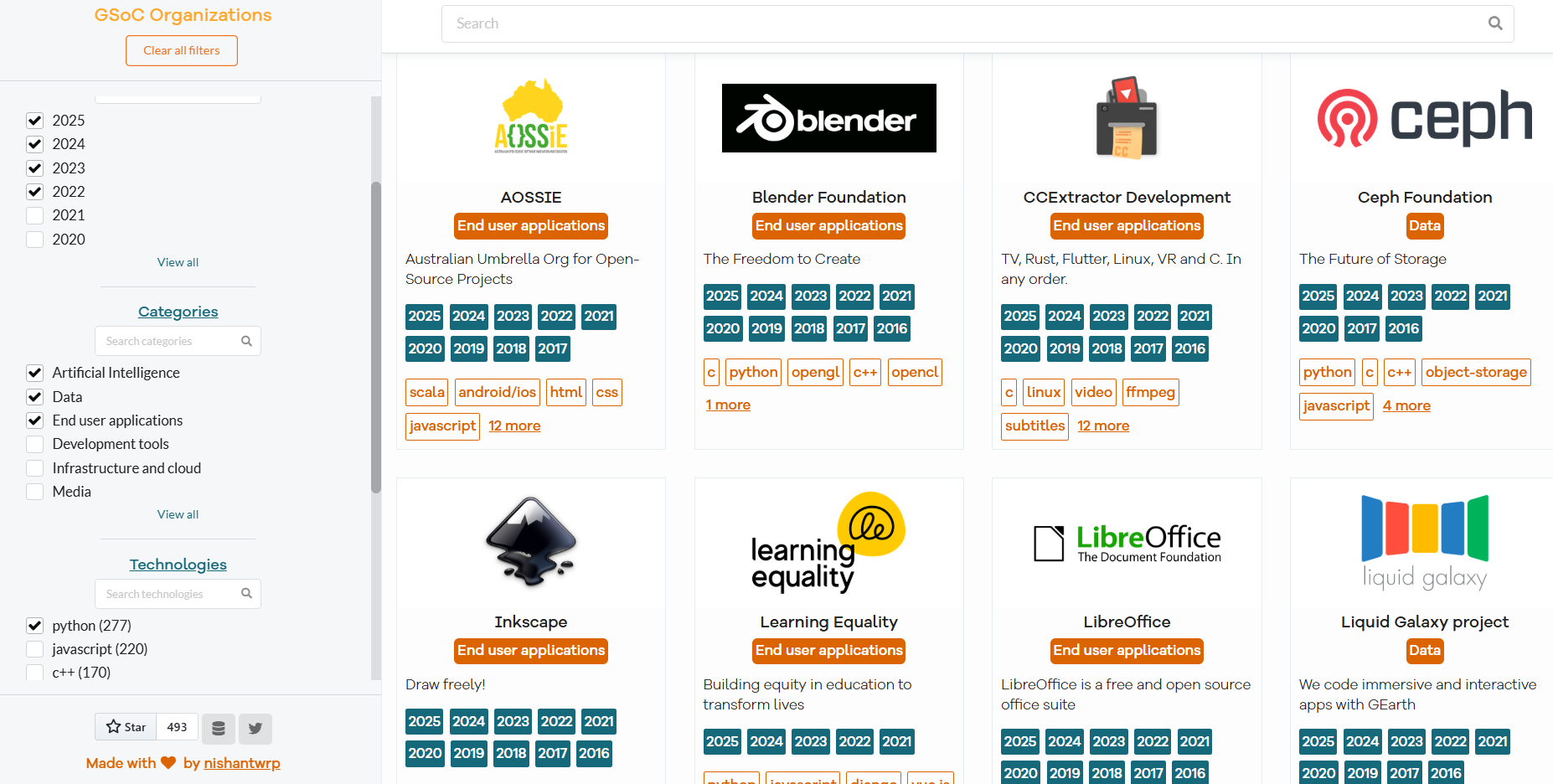
Step 2: Evaluating Organizations for Consistency and Quality
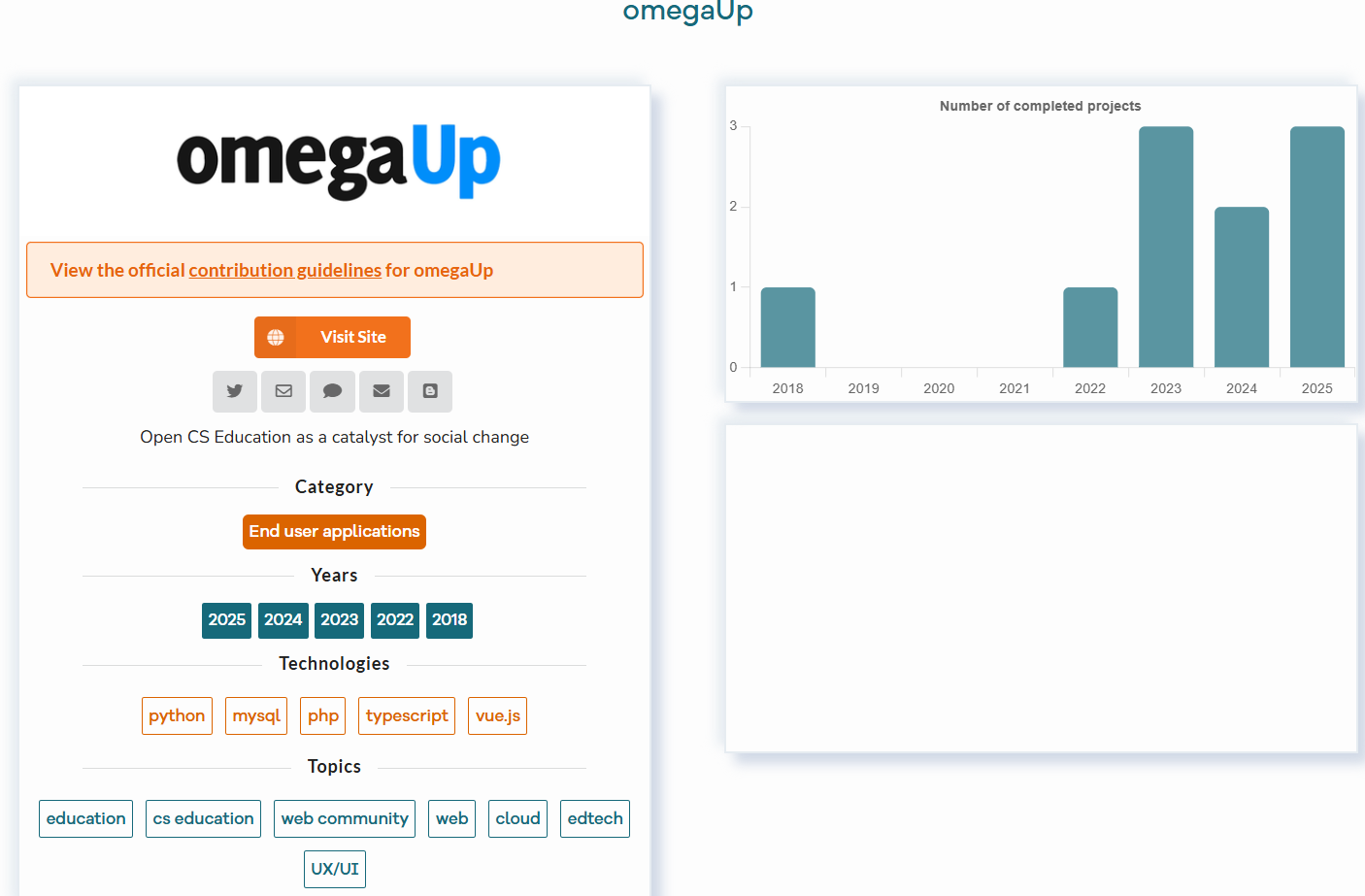
With our initial list in hand, we assess each organization using additional criteria, such as the number of projects offered and the quality of documentation. For example, we encounter “OmegaUp,” an organization with only two to three projects in recent years and a notable gap in participation from 2019 to 2021. This inconsistency suggests a lack of stability, which could hinder our experience as new contributors. To maximize our chances of success, we decide to exclude such organizations from consideration.
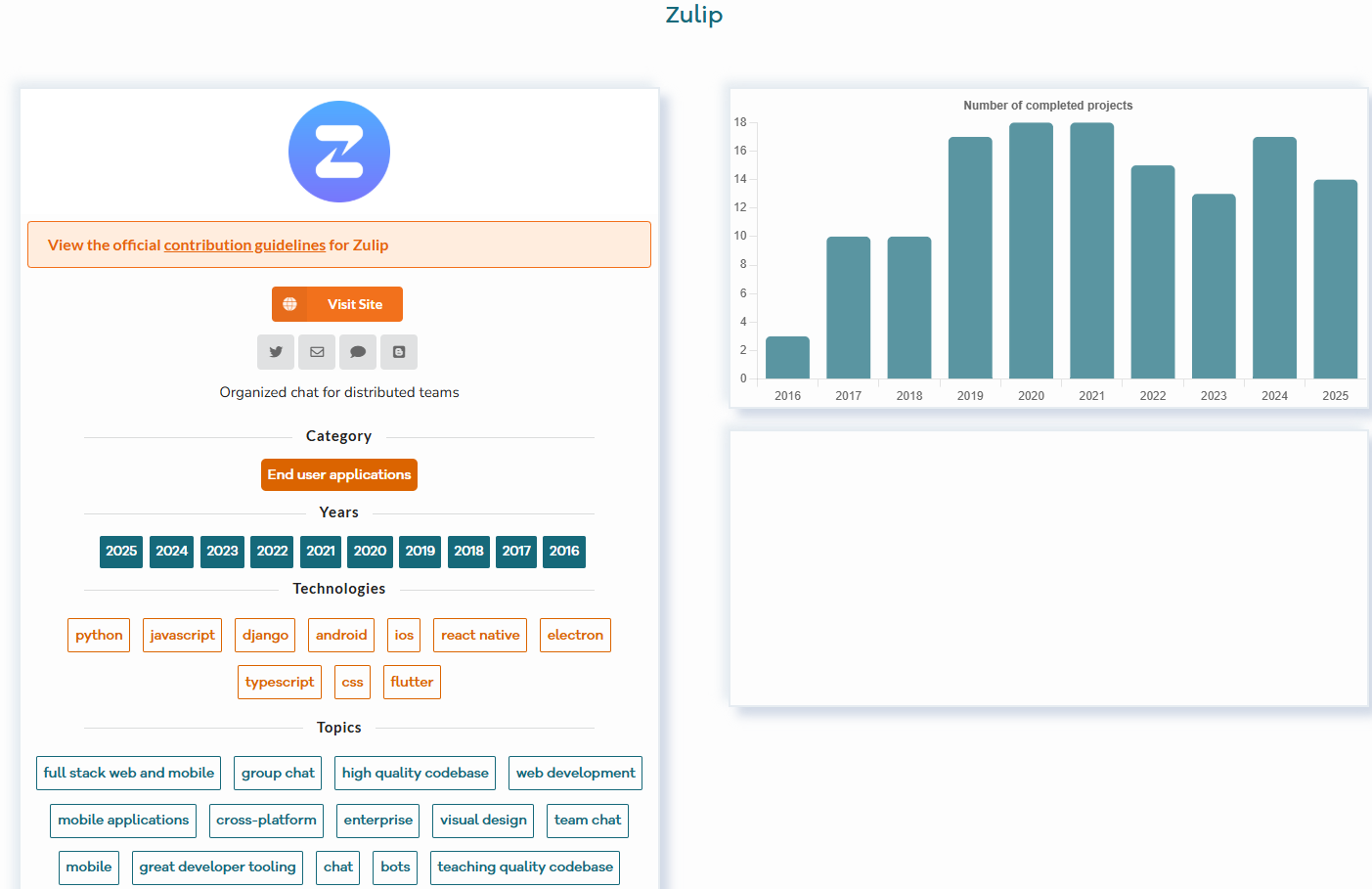
In contrast, we discover “Zulip,” an organization that has consistently offered at least 10 projects annually since 2019. This sustained activity indicates a robust GSoC program and a supportive community, making it a strong candidate for our contribution efforts.
Step 3: Gathering Detailed Information from the Official GSoC Website
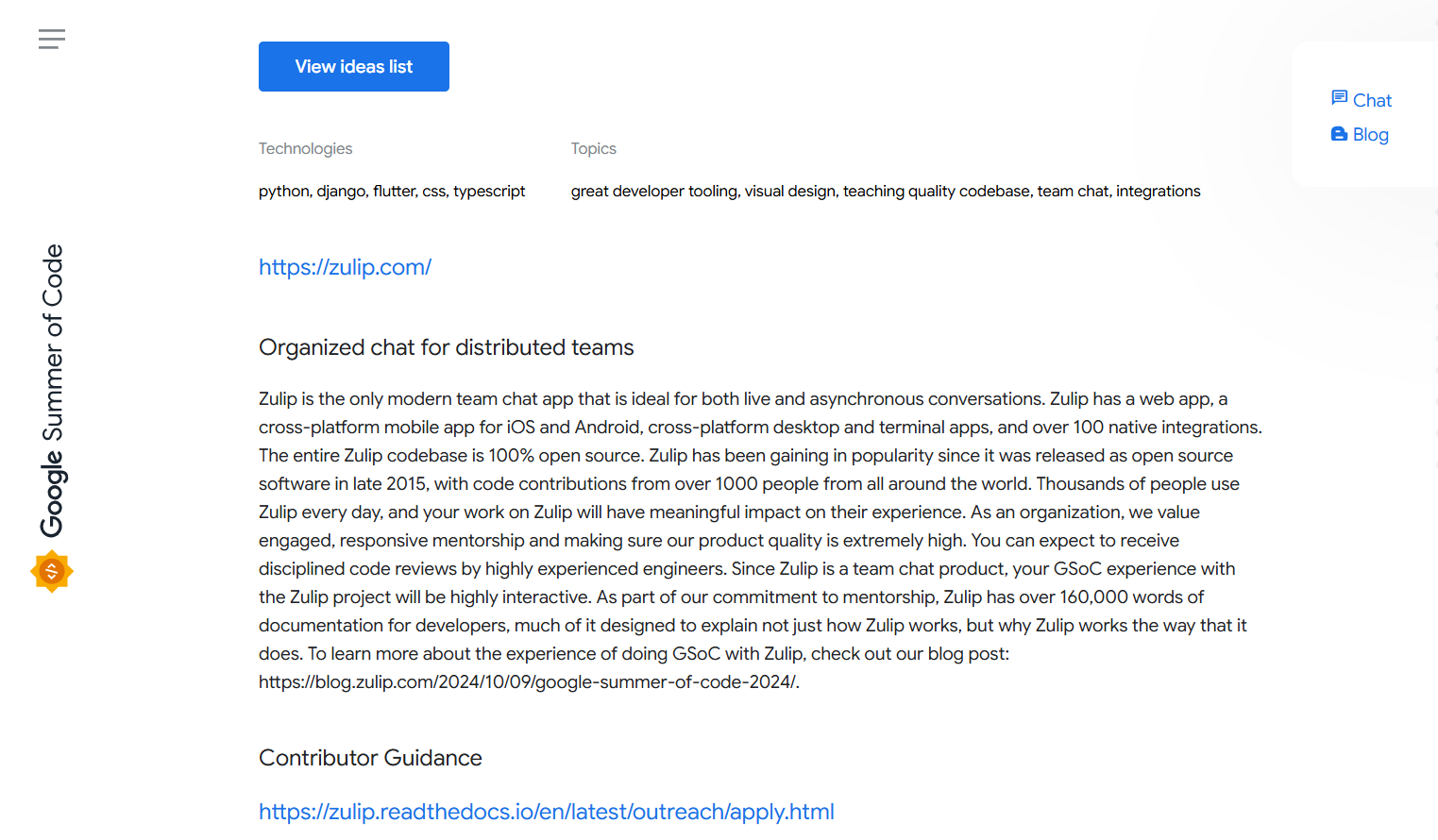
To deepen our understanding of Zulip, we navigate to the official GSoC website. This platform provides a comprehensive overview of the organization, including its tech stack, official website, and communication channels (which will help you connect with potential mentors and contributors). These details are essential for confirming that Zulip aligns with our technical skills and offers accessible avenues for engagement.
Step 4: Assessing Repository Activity on GitHub
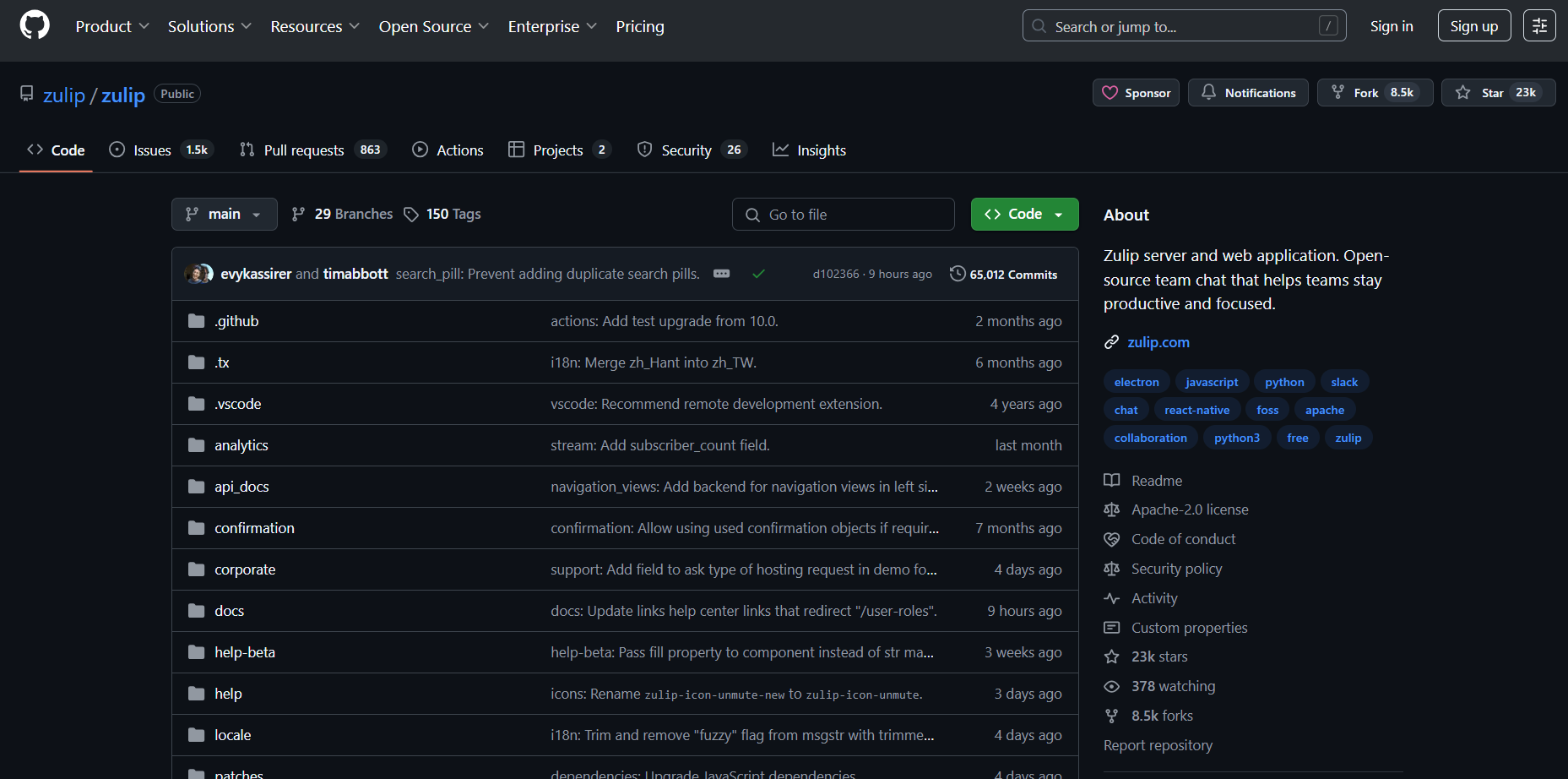
Next, we visit Zulip’s GitHub repository to evaluate its activity and reputation. The repository boasts 27,000 stars, over 1,000 issues, and approximately 800 pull requests—metrics that reflect a thriving and well-regarded project. Additionally, the README includes a quick guide on cloning and installing the repository locally, equipping us with the practical knowledge needed to set up our development environment.
Step 5: Reviewing Development Insights
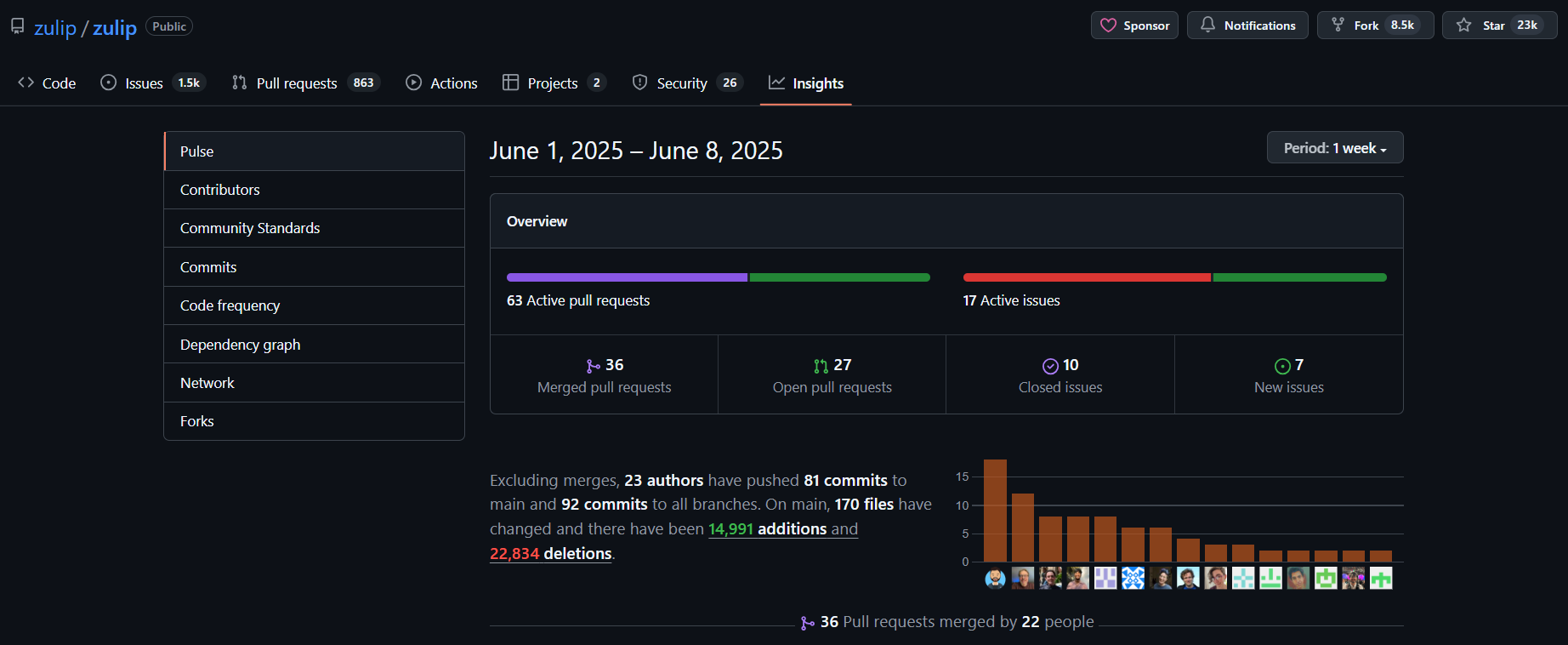
To further confirm the project’s vitality, we explore the Insights tab on GitHub. The consistent activity and maintenance visible in the graphs reassure us that Zulip is actively developed and well-supported, enhancing its appeal as a potential choice.
Step 6: Examining Documentation and Guidelines
We then access Zulip’s official website and documentation at https://zulip.readthedocs.io/en/latest/. This resource is comprehensive, offering detailed contributor guidelines, a code of conduct, and licensing information. Such well-maintained documentation ensures that we can contribute effectively while adhering to the organization’s standards.
Step 7: Identifying Beginner-Friendly Issues
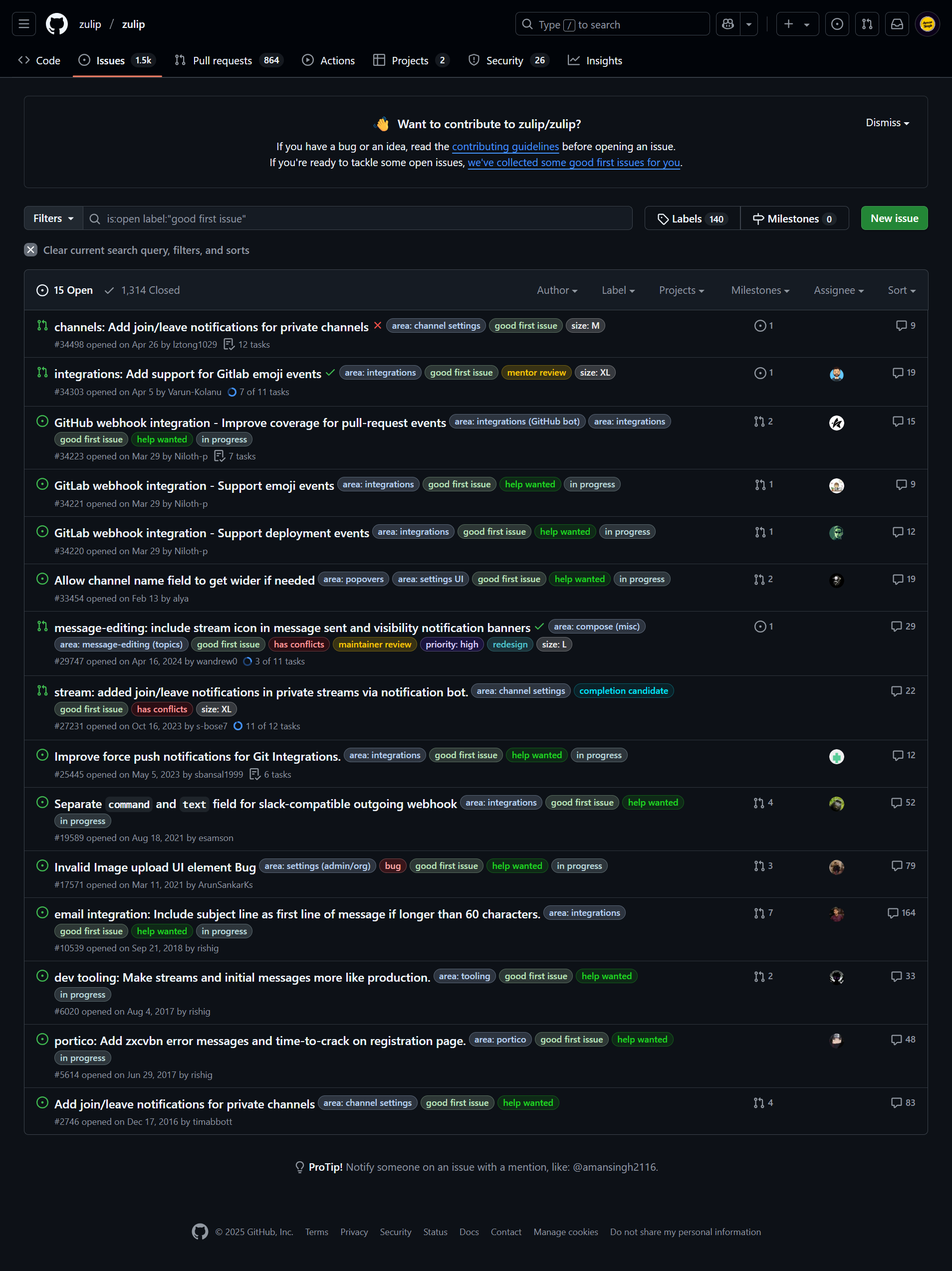
Having established Zulip as a promising organization, we shift our focus to finding suitable tasks. On the GitHub Issues tab, we filter for labels like "good first issue" and "help wanted". These tags highlight beginner-friendly issues, providing us with approachable entry points to begin contributing.
Step 8: Exploring Past and Current GSoC Projects
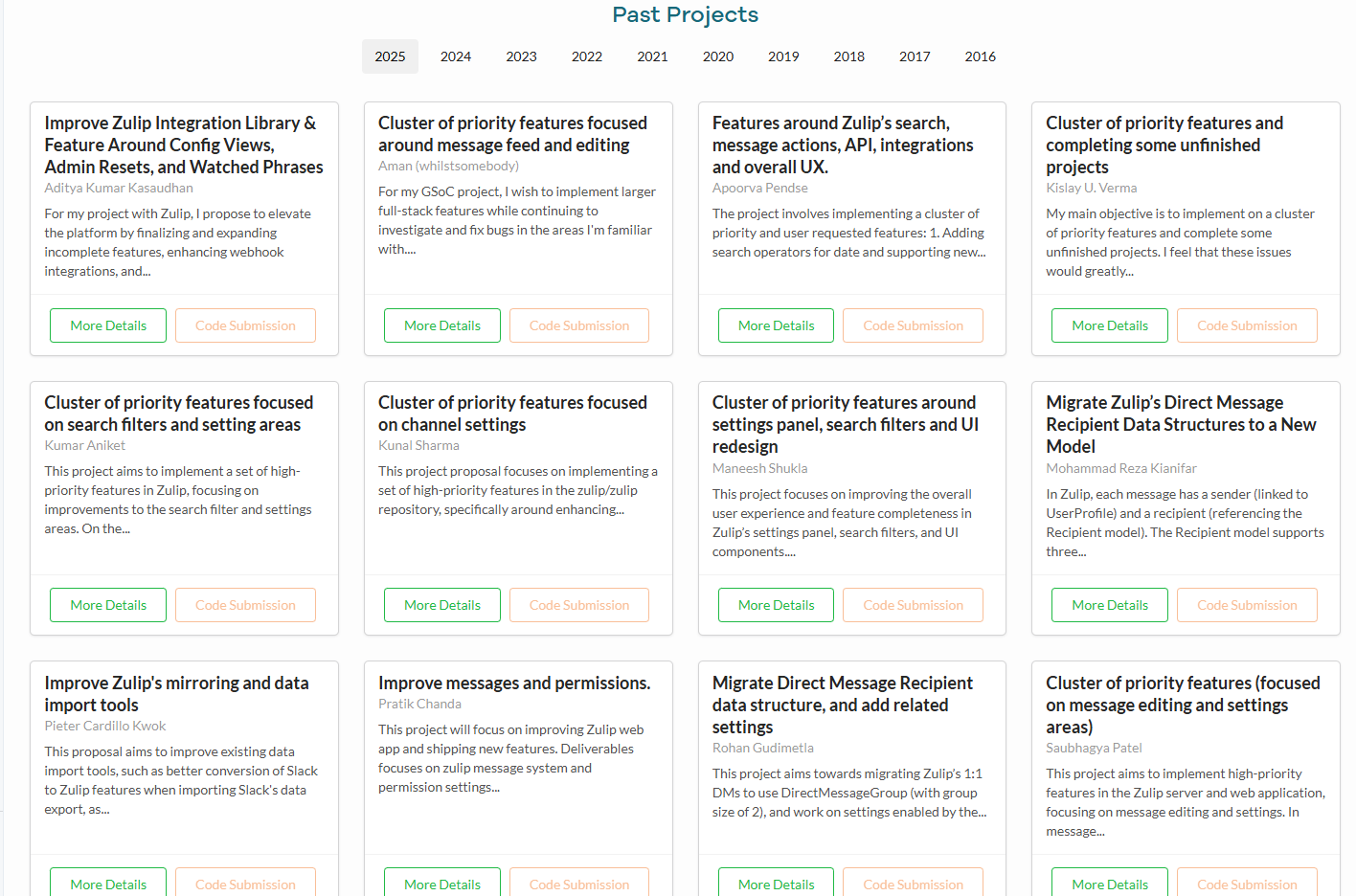
To gain insight into the types of projects Zulip offers, we return to gsocorganizations.dev to review their historical GSoC projects. This step reveals the scope and nature of past contributions.
For a more current perspective, we visit Zulip’s GSoC page at (https://zulip.readthedocs.io/en/latest/outreach/gsoc.html). Here, we find detailed descriptions of current project ideas, including required tech stacks (not the overall tech stack mentioned on GSoC website but project specific) and mentor details, enabling us to assess their fit with our capabilities.
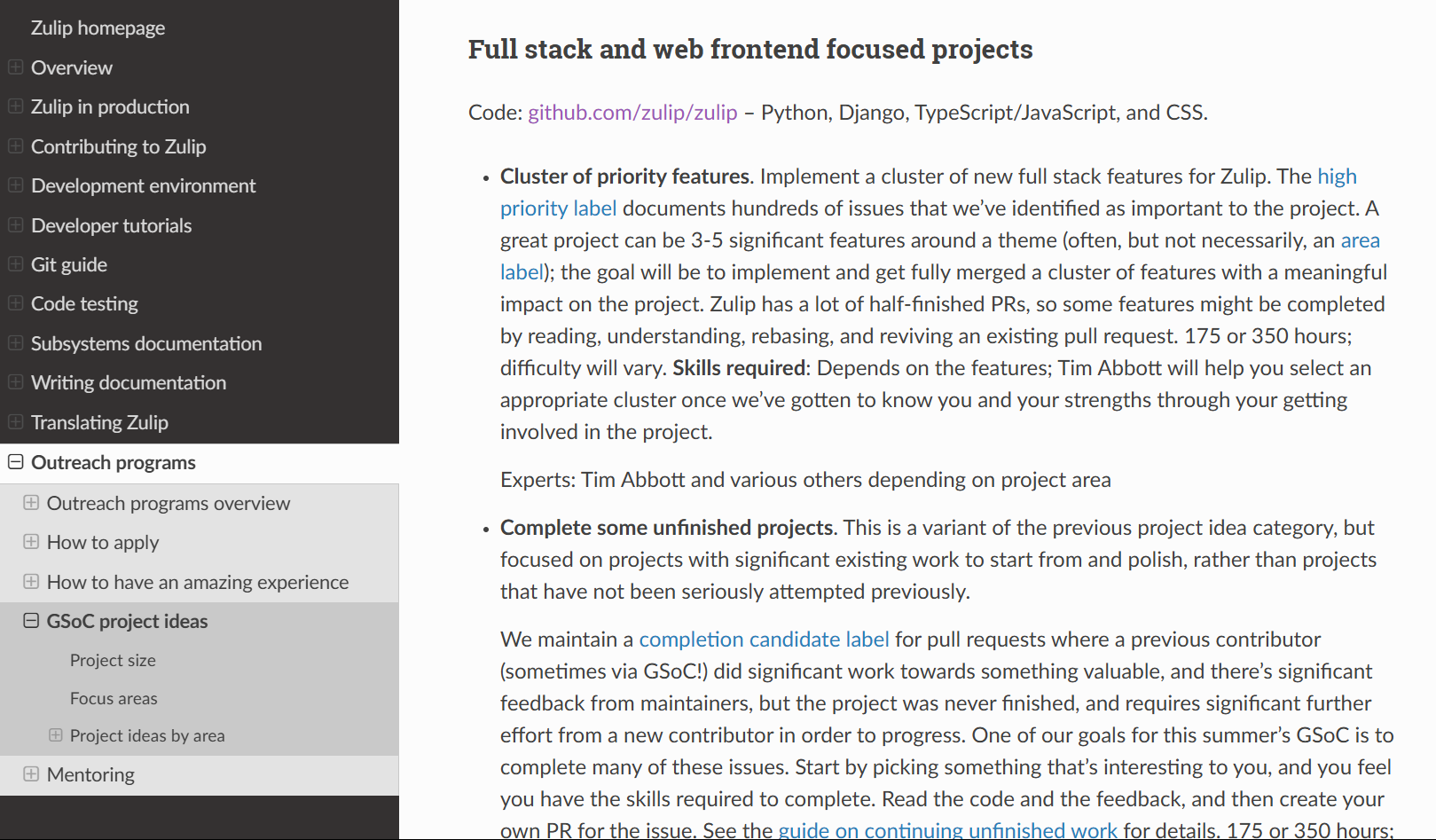
Step 9: Selecting Projects That Align with Our Interests
After exploring the available projects in depth, we identify several that resonate with our skills and interests. For instance, we might select projects involving UI enhancements or backend optimizations—areas where our Python expertise can shine. These options are documented as follows:
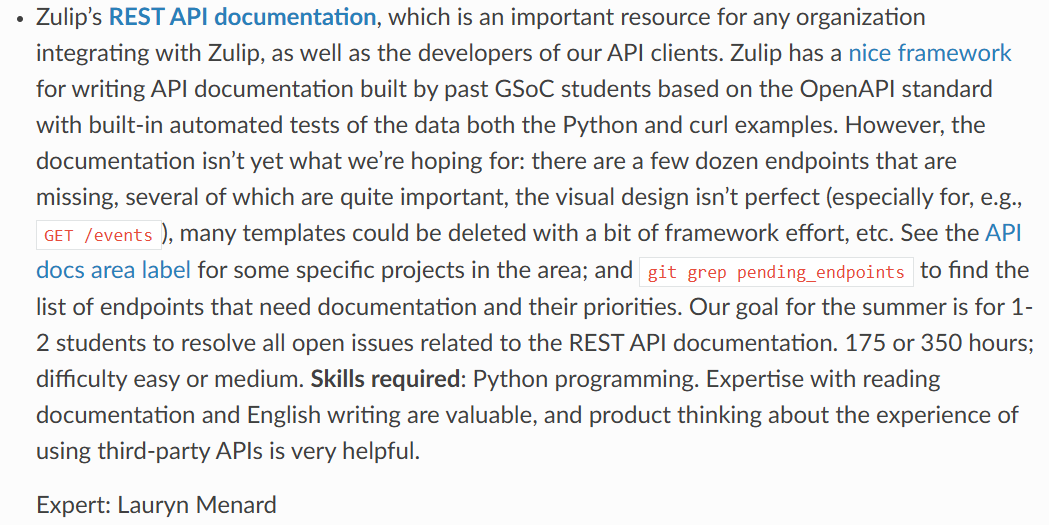 | 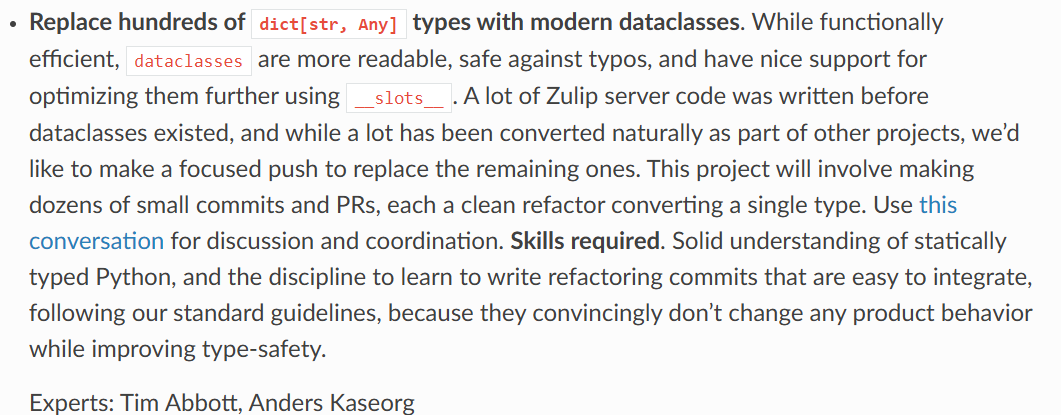 |
|---|
Next Steps
This guide gives you a clear starting point for your open-source journey, helping you find the right group and project. While it’s made to help beginners like you succeed, it’s not a strict rulebook! As you code more, learn new things, and get better at solving problems, picking projects will become easy. Soon, you’ll be ready to join more competitive groups and take on tougher challenges. Think of this guide as your first map; your path will change and grow as you do.
Contacting Organization Admins and Building a Positive Presence
Once you’ve selected an organization and identified a project you’re excited about, the next crucial step is to engage with the organization’s community and mentors. Effective communication here can make a big difference — it helps you learn faster, build relationships, and stand out as a serious and dedicated contributor.
How to Initiate Contact
There are multiple ways to reach out and connect with the organization:
Official Email: Many organizations provide an official email address. You can start by sending a polite and concise introduction about your interest in contributing.
Community Platforms: Most organizations will have one or more community channels where you can interact with mentors and contributors:
- Discord servers
- Slack workspaces
- Mailing lists (subscribe to stay updated and join technical discussions)
Contributors’ Public Contacts: Some mentors or past contributors list their emails or GitHub/LinkedIn profiles. You can reach out politely if needed, but always prioritize public channels first.
Important Tip: Avoid sending direct messages to mentors unless invited to do so — always ask questions in public channels so others can learn too and mentors aren’t overwhelmed.Remember that these experienced professionals have their own commitments, so be mindful of their time.
Building Relationships the Right Way
Once you’re connected to the community, how you interact matters just as much as what you contribute. Here’s how to make a strong, positive impression:
Show Commitment Beyond GSoC Mentors appreciate contributors who genuinely care about the project and not just the stipend or certificate. Convey that you plan to stick around and contribute long-term — even aiming to become a future mentor yourself.
Ask for Guidance Thoughtfully Don’t hesitate to ask for help — networking and learning from mentors is key! However:
- Do your homework first. Search documentation, review GitHub issues, and Google your question before posting. Value their time (people who maintain these projects are often highly experienced professionals with their own personal tasks and jobs).
- When asking, clearly explain what you’ve already tried. For example: “Hello, I am trying to achieve XYZ. I’ve followed ABC steps and looked into DEF resources, but I am stuck with this error. Could someone please guide me further?”
- This shows initiative and respect for the mentors’ time.
Start Small, Then Scale Up Begin by contributing to small, beginner-friendly issues. This helps you understand the codebase and build trust with the community. Gradually take on more complex tasks as you gain confidence.
Communicate Openly and Consistently Keep mentors updated on your progress. Regularly share your draft proposal, suggestions, and any blockers you’re facing. Consistent communication signals your active involvement and dedication — a big plus when mentors evaluate students later.
Collaborate and Help Others Engage with the community — answer questions from newcomers, help with installation or setup problems, and share helpful resources. This collaborative spirit will make you a valued community member.
What to Ask Mentors and Admins
When interacting with mentors and admins, here are some key things you can ask (once you’ve done some preliminary research):
Learning Resources Ask for recommendations on learning resources or documentation for the technologies and tools used in the project.
Good First Issues Request pointers to beginner-friendly issues that can help you start contributing and become familiar with the project.
Codebase & Installation Help If you face issues while setting up the project locally, ask for guidance — but again, explain what you’ve already tried.
Project Idea Clarifications Discuss the project idea with mentors to understand expectations and validate whether your proposed implementation plan aligns with their vision.
Engaging with mentors and the community is about more than just asking questions — it’s about building relationships based on mutual respect and shared enthusiasm for the project. If you approach this with curiosity, patience, and a willingness to learn, you’ll not only improve your chances of GSoC selection but also gain valuable experience in open source collaboration.
Learning Technologies and Starting Contributions
Once you’ve connected with an organization and its community, it’s time to roll up your sleeves and start contributing. This is often the most exciting — and the most challenging — phase of your GSoC journey. The key here is to learn by doing.
What Counts as a Contribution?
In open source, contributions go beyond just writing code. Here’s what you can do to add value:
- Fix bugs or add new features: This is usually the most impactful form of contribution.
- Report issues: Identifying bugs or usability problems is valuable feedback. As a beginner, this can be your first contribution. Also you can raise an issue yourself and ask maintainers to assign it to you, if you think you can fix it.
- Write documentation: Improving installation guides, usage instructions, or API docs is a great way to help others and show your understanding.
- Engage with the community: Testing pre-releases, offering feedback, helping others set up the project — these actions all reflect your commitment.
Each of these contributions carries weight. Implementing features or fixing complex bugs is often viewed as “heavier,” but don’t underestimate the impact of well-documented issues or a much-needed tutorial.
Why Starting Is the Hardest Part
If you’re a beginner, this phase will feel intimidating — and that’s completely normal. The hardest part is simply taking the first step. Once you push through this initial barrier and begin contributing consistently, you’ll start gaining confidence and momentum. Contributions aren’t limited to code. You can also help by pointing out issues, writing documentation, creating blogs, making videos, etc. This shows your commitment and helps the organization grow. Maintain patience and a strong willingness to learn and solve issues.
Tip: Shift your mindset — contribute not just for GSoC selection, but to genuinely support and improve the community.
Getting Started with Contributions
In Google Summer of Code, fostering a collaborative mindset is paramount, far outweighing a competitive one. Open source thrives on lifting others up and contributing to something greater than oneself. When you demonstrate a willingness to help fellow students and community members, even those also vying for GSoC slots, maintainers notice. This spirit of mutual support not only strengthens the community but also bolsters your own candidacy.
Organizations actively seek contributors who embody this collaborative spirit. If your actions hint at a “every person for themselves” mentality, it will likely hinder your success, both in gaining a GSoC spot and thriving within the community. Instead, publicly assisting others showcases your helpfulness and significantly boosts your standing with mentors. Embrace collaboration, view other students as allies, and remember: your collective efforts are building a stronger, more vibrant open-source ecosystem.
DOs
- Begin with small issues: Look for good first issues or those labeled as beginner-friendly in the issue tracker. Start small to avoid getting stuck early on.
- Engage on GitHub: Comment on issues you’d like to work on and wait to be assigned. Once assigned, proceed with your contribution.
- Follow contribution guidelines: Read the org’s contribution guidelines thoroughly. Understanding their workflow, testing practices, and coding style is essential.
- Understand the codebase: Break the project into smaller modules and study them. Set up and use the production version extensively — it’s one of the best ways to discover bugs and improvements.
- Maintain code quality: Make sure your code passes linting checks and tests before submitting a PR.
- Participate in discussions: Stay active in the organization’s public chat channels and contribute to ongoing discussions. Don’t hesitate to ask questions on the issues page.
DONTs
- Don’t prioritize quantity over quality: Submitting multiple incomplete or redundant PRs will hurt your reputation.
- Avoid unauthorized work: Don’t fix issues without assignment, and never copy code without proper attribution.
- Manage Git carefully: Familiarize yourself with Git basics to avoid merge conflicts or repository issues.
- Don’t spam maintainers: Avoid excessive tagging of maintainers for PR reviews — patience is appreciated.
- Be honest: Always be transparent about your work and progress. Misrepresenting your efforts can damage trust irreparably.
Learning While Contributing
One of the greatest benefits of GSoC is that it forces you to move from passive learning to active application. Here’s how you can approach this phase effectively:
Avoid the Tutorial Trap
It’s easy to get stuck endlessly watching tutorials. While they can provide a foundation, real learning happens when you start contributing. Applying what you learn will help solidify your understanding far better than any course can.
Learn as You Go
You don’t need to know everything before starting. Use contributions as a learning opportunity:
- Read the codebase first — understanding existing code is as important as writing new code.
- Use tools like Google, Stack Overflow, ChatGPT, Gemini, and project documentation to troubleshoot and learn.
- Collaborate with mentors and fellow contributors — asking smart, well-researched questions will accelerate your learning.
Communication and Team Spirit
Being part of an open source project is about collaboration, not just individual effort. Good communication is key:
- Regularly update mentors on your progress.
- Discuss your implementation approach before diving deep — this avoids wasted effort and shows initiative.
- Help newcomers with installation or setup questions — this strengthens your standing in the community.
Understanding the Code
If you can read and understand (not necessarily write) the project’s code, you already know enough to start contributing. Focus on reading through the codebase and understanding how different components interact.
Essential Tools & Workflow
Here are some basic tools and workflows you should get comfortable with:
Git & GitHub
Master the basic Git workflow — you’ll use this every day:
Fork & Clone: Fork the repo and clone it locally.
Build the Stable Version: Test the project locally to confirm your environment works.
Explore & Pick Issues: Use the issue tracker to select suitable issues.
Fix & Test: Implement changes and ensure they pass existing tests.
Git Workflow:
git add→ Stage your changes.git commit→ Commit with a clear, descriptive message.git push→ Push your changes to your forked repo.- Submit Pull Request → Open a PR for review.
Community Engagement
Stay connected via:
- Slack or Discord (most orgs use one)
- Mailing lists
- GitHub Discussions
- Public forums or project chats
Clean Code Practices
Follow best practices for writing clear, maintainable, and well-documented code — this will make your contributions easier to review and more valuable.
Soft & Technical Skills
Soft Skills
- Find help efficiently: Use search engines, forums, and community resources first.
- Receive feedback gracefully: Constructive criticism helps you grow.
- Work independently: Be comfortable working solo for long stretches.
- Know when to ask: Recognize when you’re stuck and reach out for help with context.
- Communicate clearly: Maintain regular, polite communication with mentors and the community.
Technical Skills
- Software setup: Be able to install and configure project dependencies independently.
- Access & reliability: Ensure you have a dedicated computer and reliable internet.
- Programming basics: Be comfortable with the language(s) and OS used in your target project.
- Org requirements: Meet the organization’s expectations — this may include submitting PRs or engaging in discussions.
By embracing this learning and contribution process, you’ll not only prepare yourself for GSoC but also gain invaluable real-world experience in open source development.
Remember: Contribute because you want to improve the project and community — not just because you want to be selected for GSoC. With this mindset, success will follow naturally.
Strategy for Success
Start with Initial Contributions: Aim to make at least 3–4 meaningful pull requests (PRs) before the application period begins. This not only demonstrates your commitment to the project but also helps you become comfortable with the codebase, the development workflow, and the community’s expectations. Early contributions signal to mentors that you are proactive and genuinely interested in supporting the project long term.
Maintain Momentum with Continued Contributions: If your chosen organization is accepted for GSoC, keep the momentum going. Continue making thoughtful contributions while simultaneously drafting your proposal — this will strengthen your application and give mentors further confidence in your abilities. If your initial organization doesn’t make it to the final list, don’t be discouraged. Leverage what you’ve learned and redirect your efforts to a new organization that aligns with your interests, repeating the same cycle of learning, contributing, and building connections.
Submitting Your Project Proposal
Once you’ve built strong rapport within your chosen organization—by actively contributing, engaging with mentors, and understanding the project’s ecosystem—it’s time for one of the most critical steps: submitting your project proposal.
Your proposal is your chance to showcase both your vision and your preparedness. It should clearly communicate how you plan to execute your chosen project, the technical depth of your understanding, and your ability to deliver results during the GSoC coding period.
Note: Your chances of selection are primarily driven by contributions, especially for older and ongoing projects, where your active involvement is the most crucial factor. Community reputation also plays a role, highlighting the importance of your interactions and presence within the project’s community. Lastly, proposal quality is significant, particularly for newer projects where a well-structured and compelling proposal carries more weight. While the proposal is important, it is not the sole determinant of success.
Engage Mentors Early
Before writing your proposal, begin by openly discussing your project ideas with mentors. This will not only help refine your understanding of what the organization expects, but will also give mentors confidence in your commitment and capability. Mentors select students based both on the quality of proposals and demonstrated contributions—building this relationship early is key.
Once students are selected, each one is paired with a mentor who will provide guidance throughout the program.
Crafting an Effective Proposal
Think of your proposal as a detailed implementation blueprint for your project idea. It should demonstrate that you have a clear vision, a structured plan, and the technical ability to execute it within the 16-week GSoC coding period.
Some organizations may provide a proposal template; if not, ask mentors for guidance on the ideal structure and content. It’s essential to get a draft proposal reviewed by mentors early, so they can suggest improvements and help you refine your submission. This feedback will not only enhance the quality of your proposal but also demonstrate your commitment to delivering a high-quality project.
One of the best ways to prepare is to review past successful proposals from the same organization. This will help you understand what the organization expects from a GSoC proposal. Analyze the applications of successful candidates to get insights into their approach and the level of detail they included.
Remember: a strong contribution history always outweighs a great proposal alone—but combining both gives you the best chance of success.
General Tips
- Use simple text on Google Docs or similar—no need for fancy formatting, it need to be well formatted but not too decorated. You may use Markdown or
LaTeX(using AI and platform like “Overleaf”), but Try to avoid using AI-generated content, as it is easily detectable and can make your proposal appear less authentic (atleast Humanize it). - Treat the proposal as a collaborative document: get feedback from mentors and iterate. A 2–3 round review cycle is ideal before final submission. You can also use GitHub Discussions or your organization’s forum to get feedback from the community and other participants.
- After submitting, don’t sit idle. The 1-month window before selected students are announced is your opportunity to keep contributing and further demonstrate commitment.
- If possible, include a small working demo (10–20%) to validate your approach and show that you’re ready to deliver results.
- Be realistic in your timeline and commitments to avoid future disappointment or stipend issues.
Recommended Proposal Structure
1. Project Name
Choose a creative name for your project—it can differ from the official idea list name.
2. Personal Details
- Name
- GitHub profile (Optimize your GitHub profile by creating a well-formatted Readme.md, showcasing your best projects, and maintaining a strong contribution graph)
- LinkedIn profile (Enhance your LinkedIn profile for visibility to mentors and relevance to target organizations and projects)
- Time zone
- Preferred chat handle
- Any other relevant acievements
3. Project Description
- A detailed abstract of the project. Create a flowchart explaining the project (its structure, features, and goals).
- Specific components and features you will develop.
- Clear articulation of the project’s goals and impact.
4. Work Done So Far
- Setup progress (development environment, building the project, researching documentation).
- Key contributions (1–5 PRs showcasing your best work). Make a table with the isuue you solved, link to the PR, and a short description.
- Include rough prototypes or proof-of-concept work already completed so they know that you can actually help solving some issue or building a new feature.
- Write your (list of) Deliverables (what you’ll build or produce, the expected outcome, and how you’ll demonstrate completion (e.g., via code commits, pull requests, or documentation). Break your project into manageable, measurable steps.)
5. Open Source Development Experience
- Past open source contributions (inside and outside GSoC).
- Contributions made to the selected organization so far.
- Relevant side projects (preferably open source). You can build projects related to the project you are applying for, showcasing your capabilities and showing that you are capable of working on and completing the project.
- Releavant blogs if you have published.
6. Project/Internship Experience
- Summarize any internships or significant project experience, especially related to the selected project and organization.
Important note: The order of sections in your proposal should be adjusted based on your contributions. If you have few or no merged pull requests in the organization you are applying to, it is better to rank your relevant related projects first. On the other hand, if you have already made a few contributions, show them first and then list your projects and other experiences. This will help highlight your achievements and make your proposal more effective.
7. Timeline
- Provide both a high-level percentage breakdown and a detailed phase-by-phase weekly timeline (Community Bonding, Coding Phases, Evaluations).
- Include estimated time for mentor reviews in your plan.
- A tabular representation is preferred.
- As you plan your contributions, take a moment to be really honest with yourself about your timeline and how much consistent effort you can put in. It’s easy to get carried away with excitement, but overestimating your time or exaggerating your progress can lead to unnecessary stress or even issues later on. Remember, your mentors and maintainers have been there, done that – they have a realistic grasp of how long a project usually takes. Being transparent from the start not only sets you up for success but also fosters a healthy, trusting relationship with your team.
8. Academics
- Institution name.
- Relevant coursework or certifications.
9. Why This Organization & Project?
- Why you want to work with this particular organization.
- Why this project excites you and how you plan to contribute meaningfully.
10. Why Me?
- Highlight your unique strengths and fit for the project.
- Describe your primary tech stack and skill set.
- Provide evidence to support your claims, such as previous work, projects, certifications, achievements, and your learning mindset.
11. Planned Work Hours - Commitments
- Clearly outline your dedicated hours to the project, including working hours details, estimated work hours per week, and any other commitments that may impact your availability (e.g., exams, vacations, etc.). State, what your weekly time commitment will be and any other obligations during the GSoC period.
- Be realistic when estimating your workload, as failing to complete the project or meeting midterm evaluation deadlines can impact your stipend.
- Additionally, indicate if you plan to maintain a blog to track your progress and share updates with your mentors and the community.
12. Communication Plan
- Your preferred contact channels and frequency.
- Future engagement—how you plan to contribute even after GSoC ends.
Do’s
Provide Technical Depth
- Instead of saying, “I will implement this feature,” explain the methods, tools, and steps you will use.
- Describe methods, tools, and your step-by-step approach.
Align with Organization Guidelines
- Follow any provided sample templates or proposal guidelines meticulously.
Be Concise but Complete
- Keep the proposal well-structured and ideally within ~10-15 pages.
- Use UI/UX mockups, workflow flowcharts, and diagrams where helpful. Visual aids can make complex ideas clearer.
Show Relevant Experience
- Include relevant technical experiences and open source contributions.
- Don’t copy your full CV—customize this section for your project.
Maintain Communication
- Share draft proposals with mentors and incorporate their feedback.
- Continue active engagement and contributions even after submission.
Present a Detailed Timeline
- Offer a well-reasoned weekly plan with key milestones.
- Clearly mention technologies and frameworks you will be using.
Don’ts
Leave the Project Idea Ambiguous
- Clearly state what you aim to achieve through your project.
Recycle Proposals
- Avoid using a generic template across multiple organizations—tailor each proposal.
Submit a Vague Timeline
- Replace high-level statements with a concrete breakdown of tasks and timelines.
Paste Your CV
- Customize experience to suit the project—irrelevant details indicate low effort.
Overpromise Without Proof
- Show realistic goals with supporting evidence (working code or small prototypes).
Let Enthusiasm Replace Competence
- Express enthusiasm, but back it with evidence of your skills and preparation.
Confuse Software Usage with Development Ability
- Demonstrate development-relevant skills—simply using a tool isn’t enough.
Leave Template Residue
- Proofread to remove any placeholder text or template credits.
Over-Rely on External Links
- Ensure your proposal is self-contained. External links should be supplementary only.
Describe Skills Vaguely
- Avoid terms like “Good” or “Basic”—instead, give specific examples of how you’ve used a skill.
Mention Financial Motivation
- Never mention that your primary motivation is monetary—focus on learning and contributing to the community.
A final reminder: your proposal is the bridge between your contributions and your selection. It’s not just a document—it’s a reflection of your intent, effort, and ability to make a lasting impact. Pair it with consistent contributions and community engagement, and you’ll greatly improve your chances of standing out.
Strategy
Aim to prepare and submit 2–3 strong proposals to 2–3 different organizations.
If you start your preparation early, you’ll have ample time to explore multiple organizations and contribute meaningfully to several projects in parallel. This not only broadens your exposure and learning but might also increases your chances of getting selected, as it gives you multiple opportunities across different organizations.
Applying to multiple organizations and multiple projects might seem like a way to boost your odds, but it rarely is. The competition in GSoC is fierce, and spreading your efforts across several projects means you won’t be able to dedicate your full attention and best work to any single one. Focus on delivering high-quality contributions to one or two organizations where you can truly excel.
Some sample selected proposals
https://docs.google.com/document/d/1Ba0DrybjCMXE5YzLwMdvAEyxjwBN68CL6SDJe48GWl4/edit
https://docs.google.com/document/d/1x7wmcnavtCNO9uTkwpHuIAE82tK5ehiar_XjVJW_PyI/edit
https://docs.google.com/document/d/1LFCOhmHBrkTWBPdP2c2lBh9wUTKeC0m7X0YZx4I_csY/edit
https://drive.google.com/file/d/1Rxu-ZPzrZ1UUAMennR6Y-gecFXUlnHNq/view
https://drive.google.com/file/d/1tG33LLWhy2lApiXaPl1ukRv7xho0V-Ne/view
https://docs.google.com/document/d/1yMwO6YGn6LA-d2KokM3am6I6oW-BK9Lya9baetpRR2Y/edit
LibreOffice - Gautam Prajapati Proposal (google.com)
GSoC_archive/2023 at main · Aritra8438/GSoC_archive (github.com)
📅 Detailed Timeline & Steps to Follow to Win GSoC
Below is a structured timeline designed to help you stay on track throughout the year as you prepare for GSoC. Please note that this is a general guide — exact dates and milestones may vary slightly each year based on the official GSoC schedule.
Also, keep in mind that the goal of this blog is not solely to “crack” GSoC, but to encourage you to learn, grow, and contribute meaningfully to open source. The timeline below is an ideal roadmap, not a rigid rulebook. Every contributor’s GSoC journey is unique — some may start in October with prior experience, while others may begin in January with limited knowledge of the tech stack — and both paths can lead to success.
Ultimately, the key is to focus on learning, building technical and problem-solving skills, improving communication and collaboration abilities, and becoming a valued member of the open-source community helping the society and not for profit.
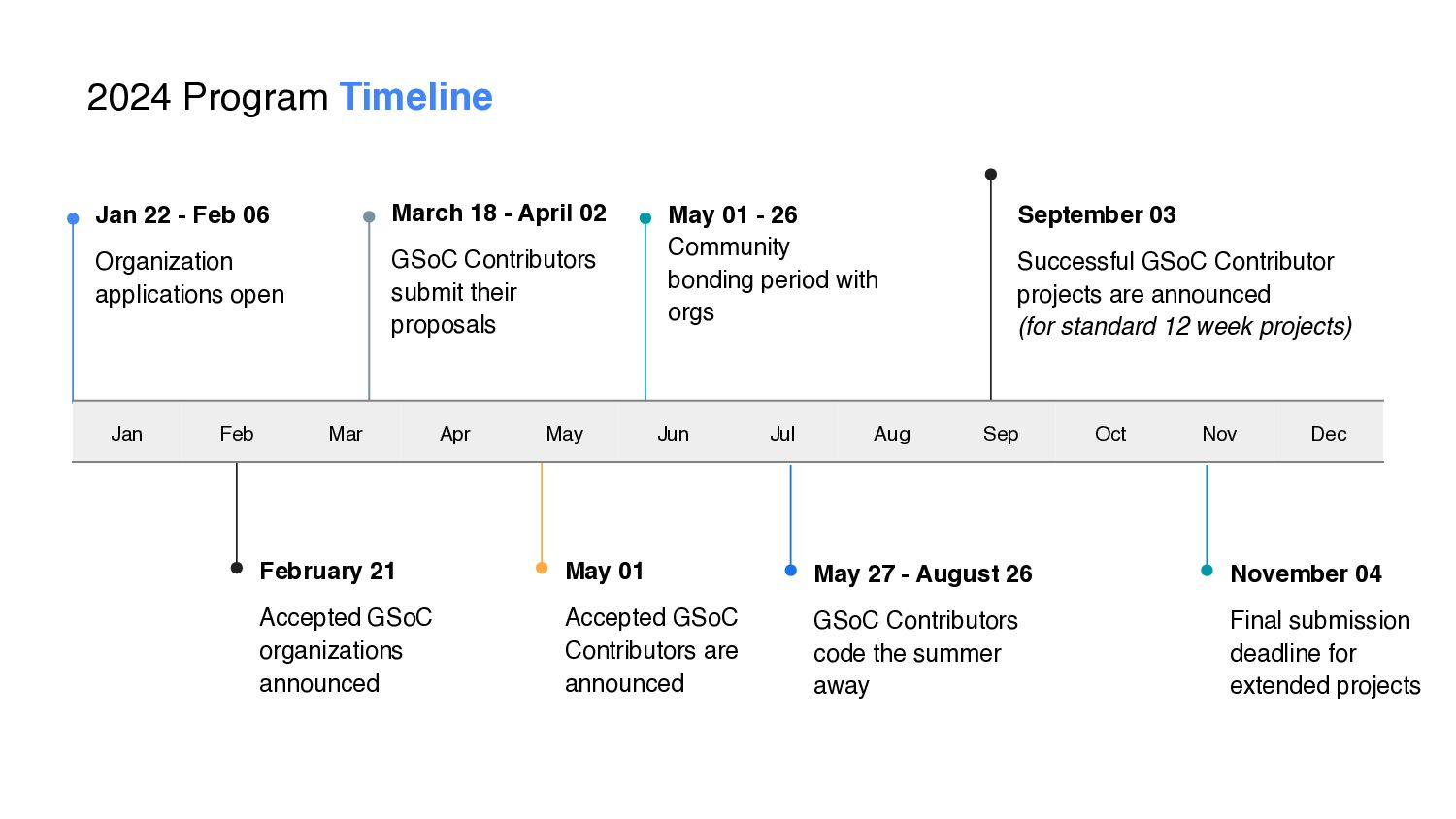
🎃 October — Getting Started with Open Source
- Starting early is the best way to succeed in GSoC.
- Kick off your open-source journey by participating in Hacktoberfest or similar open-source initiatives.
- Start exploring beginner-friendly repositories. Use resources like goodfirstissue.dev to find issues you can contribute to.
- Focus on learning the fundamentals of Git, GitHub, and collaborative development workflows.
🍁 November — Exploring Organizations & Building Relationships
- Shortlist at least 2 potential organizations that align with your interests and skills.
- Begin learning the tech stack used by these organizations.
- Introduce yourself to the community and start engaging with maintainers and mentors via mailing lists, chat platforms (Slack, Discord), and GitHub discussions.
- Focus on building genuine connections, not just transactional interactions.
❄️ December — Building a Reputation through Contributions
- Contribute actively to your selected organization(s). By now, you should aim to have a decent reputation within the community.
- Solve beginner-level issues and gradually move on to more complex bugs/features.
- Deep-dive into the project documentation and architecture — strive to understand how the project works under the hood.
- Review patches/PRs of other contributors — this enhances your ability to read and understand unfamiliar code, a crucial skill in GSoC and open source.
🎆 January 22 — Scaling Up Contributions
Organizations begin submitting their applications to Google.
Increase the quality and complexity of your contributions:
- Start working on larger issues that require deeper understanding of the codebase.
- Aim to solve problems independently without always relying on maintainers.
Evaluate the competitiveness within your chosen project:
- If you notice that someone with significantly stronger contributions has entered the space, be pragmatic — consider shifting to another project within the organization or to another organization entirely.
- Remember: Don’t get emotionally attached to one project — GSoC is about finding the best fit where you can make meaningful contributions.
- While it does happen that at the start a lot of people are too curious and motivated to contribute even small changes which fades over time and end up having only a few proposal submission, but if you can clearly see someone better has joined the organization, you should consider moving on to differnt organization.
🗓️ February 6 — Organization Application Deadline
Mentoring organization application submission closes.
Focus on making your contributions stand out — at this stage, your work speaks louder than your proposal.
- 70% of your selection chances are based on contributions. Especially for old and ongoing projects, the contributions are the most important factor.
- ~10% is community reputation.
- ~20% is proposal quality. While the proposal is important, it is not the only factor. For the new projects, the proposal quality is the more important factor.
🕒 February 6 - 20 — Internal Review Period
- Google reviews submitted organization applications.
- Continue making consistent contributions — don’t slow down.
🗓️ February 21 — Accepted Organizations Announced
- List of accepted organizations is published.
- If your organization is listed — great! If not, pivot quickly to one of your backup organizations and start contributing and building relationships there.
🗓️ February 22 — Discussion with Mentors
- Begin detailed discussions with mentors about your potential project ideas.
- Seek feedback, refine your project scope, and align your vision with the organization’s expectations.
🗓️ March 18 — Proposal Drafting & Application
- Contributor application period begins.
- Submit a well-researched and mentor-reviewed proposal (refer to earlier Proposal Guidelines section).
- Show proof of work — having completed 10–20% of the project in advance strongly demonstrates your capability.
🗓️ April 2 — Application Deadline
- Proposal submission deadline.
- After submission, do not go idle — continue contributing to your project to strengthen your case for selection.
🗓️ April 24 — Proposal Ranking
- Organization admins submit rankings of contributor proposals.
- Consistent contributions during this period can still impact your ranking positively.
🗓️ May 1 — Selected Contributors Announced
- Accepted projects are revealed.
- Important note: Not every idea from the ideas list is guaranteed to be selected — always have 2-3 project ideas prepared (only when you are confident for each of them, otherwise choose one only and give your 100% effort to it).
- Focus on making impactful contributions that solve actual problems for the project — impact matters more than appearance. Make contributions that actually solves the problems of maintainers
🗓️ May 1 - May 26 — Community Bonding Period
No official coding yet — spend time:
- Deepening relationships with mentors and community members.
- Improving project setup, understanding new areas of the codebase.
- Participating in discussions and organizational workflows.
Every organization has their own way of evaluating students. Some organizations require weekly updates/blog posts — this is a great practice even if optional. This will clearly show your progress and what you’ve learned.
🛠️ May 27 — Official Coding Begins!
- Time to execute the project as per your proposal and mentor guidance.
- Adhere to timelines, communicate regularly with mentors, and maintain high code quality.
🗓️ July 8 - July 12 — Midterm Evaluations
Conduct a review with your mentor:
- Discuss what’s going well.
- Identify any blockers or areas for improvement.
- Adjust the project scope or approach if necessary.
If your performance is strong, this is the perfect time to pick up the pace and finish strong.
🛠️ July 12 - August 19 — Final Work Period
- Continue building and refining the project.
- Ensure that all features, documentation, and tests are complete.
- Write clean and maintainable code — the project will live on after GSoC.
🗓️ August 19 - August 26 — Final Submission Week
- Submit your final work product and complete the final mentor evaluation.
- Ensure that documentation is polished — this is often neglected but critical.
- Aim to exceed your mentor’s expectations — they will ultimately evaluate your performance.
🗓️ August 26 - September 2 — Mentor Final Evaluations
- Mentors submit evaluations for your project.
- Stay available to address any last-minute feedback or questions.
🏆 September 3 — GSoC 2025 Results Announced
- Celebrate your success!
- Regardless of the outcome, you’ve built valuable experience and connections.
🗓️ September 3 - November 4 — Extended Coding Period (if applicable)
- Contributors with extended timelines continue working on their project.
🗓️ November 4 & November 11 — Final Wrap-Up
- Final submissions and evaluations for extended projects.
Final Words
That concludes this post. Believe in yourself, stay consistent, and keep learning. Communicate openly with mentors, stay patient, and trust the process.
Even if you’re not selected for GSoC this year, don’t get discouraged – you can always try again next year! Often, it simply means Google didn’t allocate enough slots to your chosen organization. Plus, some organizations might even offer you a chance to switch to another project with a similar stipend, all without Google’s direct involvement. Regardless of the outcome, you will have gained valuable skills, experience, and connections that will serve you well in your open-source journey and beyond.
You can also explore and try some more open-source programs as follows:
LFX Mentorship
- When it Happens: LFX Mentorship (formerly Community Bridge) runs in multiple cohorts throughout the year, typically Spring, Summer, and Fall. This means you don’t have to wait a full year if you miss one cycle. Keep an eye on their official website (mentorship.lfx.linuxfoundation.org) for specific application windows for each cohort.
- What it’s Mostly About: LFX Mentorship primarily focuses on cloud-native technologies and projects under the umbrella of the Linux Foundation and Cloud Native Computing Foundation (CNCF). So, if you’re into Kubernetes, Prometheus, Istio, or other cutting-edge cloud technologies, this program is a goldmine for gaining hands-on experience.
- Important Things to Note:
- Application Process: Unlike some programs where you apply directly to the central program, with LFX, you apply directly to individual organizations and their specific projects. Each project will have its own requirements and application process.
- Early Bird Gets the Worm: This is crucial advice! The deadline for many popular and easier-to-get-into projects may pass very quickly. It’s highly recommended to start researching and applying as early as possible within the application window. Why? Because the most sought-after projects and organizations tend to fill up rapidly, leaving you with fewer options later on. You might find yourself with only projects requiring a very different tech stack than your own, which could be a bigger learning curve for a first mentorship.
- Mentorship Model: It’s a structured mentorship, where you work closely with a mentor from the open-source project.
MLH Fellowship
- When it Happens: The MLH (Major League Hacking) Fellowship runs in seasonal batches – Spring, Summer, and Fall. This continuous cycle provides frequent opportunities to apply throughout the year.
- What it’s Mostly About: The MLH Fellowship offers various programs, often focused on open-source development, but also specific tracks like Web3 or Production Engineering. Their open-source tracks involve contributing to real-world open-source projects. The specific tech stacks can vary widely depending on the projects available in each batch, but they often cover popular languages and frameworks.
- Important Things to Note:
- Cohort-Based Learning: You’ll be part of a small, supportive cohort of fellows, working collaboratively on projects. This is fantastic for building a network and learning from peers.
- Application Process: The application process typically involves an initial application, technical interviews (which may include coding challenges), and behavioral interviews. They look for passion, eagerness to learn, and teamwork skills.
- Project-Based Focus: Fellows are usually assigned to specific open-source projects or work on a larger project with a mentor, focusing on a particular feature or set of bug fixes.
- Benefits: It’s a great way to gain professional software development experience, contribute meaningfully to open source, enhance your resume, and connect with a global community of developers. It’s often seen as a stepping stone for careers in tech.
Outreachy
- When it Happens: Outreachy runs in two main cohorts each year:
- May to August (Northern Hemisphere Summer): Applications usually open around February/March.
- December to March (Northern Hemisphere Winter): Applications usually open around September/October. This bi-annual schedule means you have regular chances to apply if you miss a round.
- What it’s Mostly About: Outreachy is truly special because its primary goal is to support and bring people from groups traditionally underrepresented in tech into open source. This includes, but is not limited to, women, gender minorities, people of color, LGBTQIA+ people, and people with disabilities. The program offers a wide variety of project types.
- Important Things to Note:
- Paid Internships: Outreachy provides a generous stipend (currently $7,000 USD) to participants for their 3-month remote internship, making it a truly accessible opportunity for many.
- Diverse Project Scope: Projects are incredibly diverse! They’re not just about coding. You’ll find opportunities for:
- Coding (across many different languages and domains)
- Documentation
- Design (UI/UX)
- Quality Assurance (QA) / Testing
- Community Management
- And more! This is fantastic if your strengths lie outside traditional coding.
- Application Process: The application process is multi-phased. It starts with an initial application, followed by a one-month contribution period. During this period, applicants are encouraged to make small, mentored contributions to projects they’re interested in. This helps you get familiar with the project and allows mentors to assess your engagement and learning style. It’s a great way to “try before you commit.”
- Mentorship: You work closely with experienced mentors from the participating open-source projects.
- Focus on Inclusivity: The emphasis on creating a welcoming and inclusive environment makes Outreachy a particularly supportive place for a first major open-source experience.
- When it Happens: Outreachy runs in two main cohorts each year:
Google Season of Docs (GSoD)
- When it Happens: Google Season of Docs typically runs around the middle of the year, often overlapping with or immediately following the Google Summer of Code period. Key dates for applications and project selections are usually announced in Spring.
- What it’s Mostly About: Unlike GSoC which focuses on coding, GSoD is specifically for technical writers. If you have a knack for explaining complex technical concepts clearly, creating user-friendly guides, or organizing information, this program is absolutely perfect for you!
- Important Things to Note:
- Connecting Technical Writers with Open Source: The program’s core goal is to bring skilled technical writers into open-source projects to improve their documentation. Many open-source projects have amazing code but struggle with clear, comprehensive documentation, which can be a barrier for new users and contributors.
- Project Types: Participants work on a variety of documentation tasks, such as:
- Creating new user guides or tutorials.
- Improving existing API documentation.
- Restructuring project wikis or websites.
- Developing contribution guidelines for documentation itself.
- Application Process: The process involves open-source organizations proposing documentation projects to Google. Once projects are accepted, technical writers (the “contributors” in this program) then apply to work on those specific projects. Your application will often involve submitting a proposal that outlines how you plan to tackle the documentation task and samples of your technical writing.
- Stipend: GSoD participants receive a stipend from Google for their work, similar to GSoC contributors, making it a compensated technical writing internship.
- Mentorship: You’ll work under the guidance of a mentor from the open-source project who provides context and feedback on the documentation.
Exploring these programs can open up even more doors to making your first open-source contribution beyond GSoC, each with its own unique benefits and learning opportunities!
Above all, always be polite, maintain good open-source practices, and show respect for the community and its contributors. Focus on contributing meaningfully whether in GSoC or elsewhere success will follow.
Curious about my own journey? You can read about my first PR here and explore more about open source and how to contribute here.
Thank you !